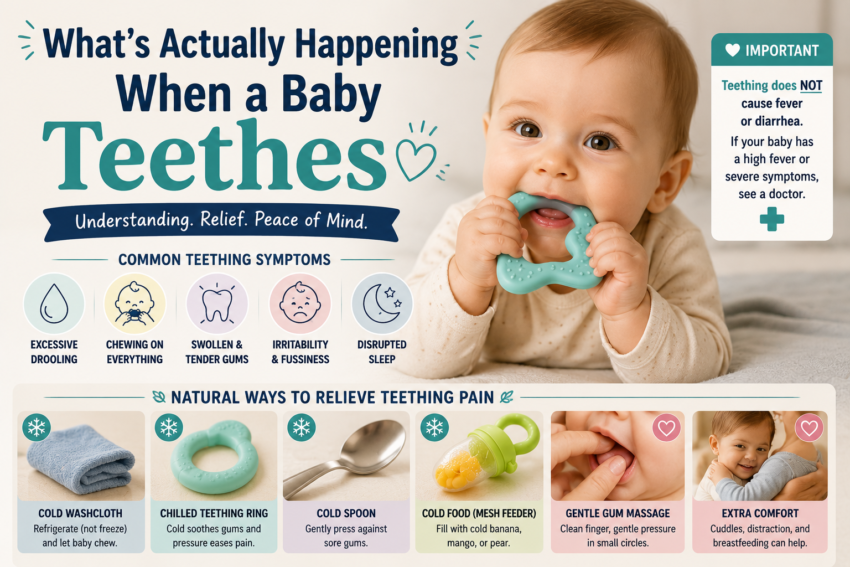
What’s Actually Happening When a Baby Teethes
Teething usually starts somewhere between 4 and 7 months, though some babies start earlier and some later. The first teeth to arrive are typically the bottom front teeth, followed by the top front teeth, then the molars — which tend to be the most uncomfortable because of their larger size.
What’s causing the pain is straightforward: a tooth pushing through gum tissue. The gum becomes inflamed and tender, and babies feel that pressure and soreness the same way adults feel a bruised gum.
A few things worth knowing before we get into remedies:
Teething does not cause fever. This is one of the most persistent myths in parenting. Teething can cause a very slight rise in temperature — a degree or so — but it doesn’t cause a true fever (38°C/100.4°F or above). If your baby has a real fever during teething, something else is causing it and it deserves a doctor’s attention.
Teething doesn’t cause diarrhea either. A widespread belief, but not supported by evidence. If your baby has significant diarrhea, look for another cause.
Symptoms that are genuinely linked to teething: drooling (a lot of it), chewing on everything, swollen and tender gums, irritability and disrupted sleep, and sometimes a mild rash around the mouth from excess drool.
Every baby is different. Some sail through teething with barely a fuss. Others find it genuinely painful. If your baby seems distressed, that distress is real — even if it’s hard to know exactly how much any individual tooth hurts.
Does Natural Teething Relief Actually Work?
Honestly — some things work, some things don’t, and a few popular remedies are actively unsafe.
The remedies with the best evidence behind them are the simplest ones: cold and pressure. They work for the same reason ice helps a bruise — reducing inflammation and providing counter-stimulus that interrupts the pain signal. Neither requires a product, a prescription, or a trip to the pharmacy.
Herbal remedies like chamomile have limited but generally positive evidence and are considered safe in appropriate forms for babies. Beyond that, the evidence gets thin fast.
What genuinely doesn’t work — and in some cases causes real harm — are several products that have been widely marketed to parents for years. The short version: teething gels with benzocaine, belladonna tablets, and amber necklaces have all been flagged by the FDA and pediatric organizations for serious safety reasons. We cover those in detail below.
The good news is that the safest remedies are also the most effective ones. You don’t need anything fancy.
Cold — The Simplest and Most Effective Natural Remedy
Cold numbs, reduces inflammation, and gives babies something satisfying to chew on. It’s the single most effective natural approach to teething pain, and it costs almost nothing.
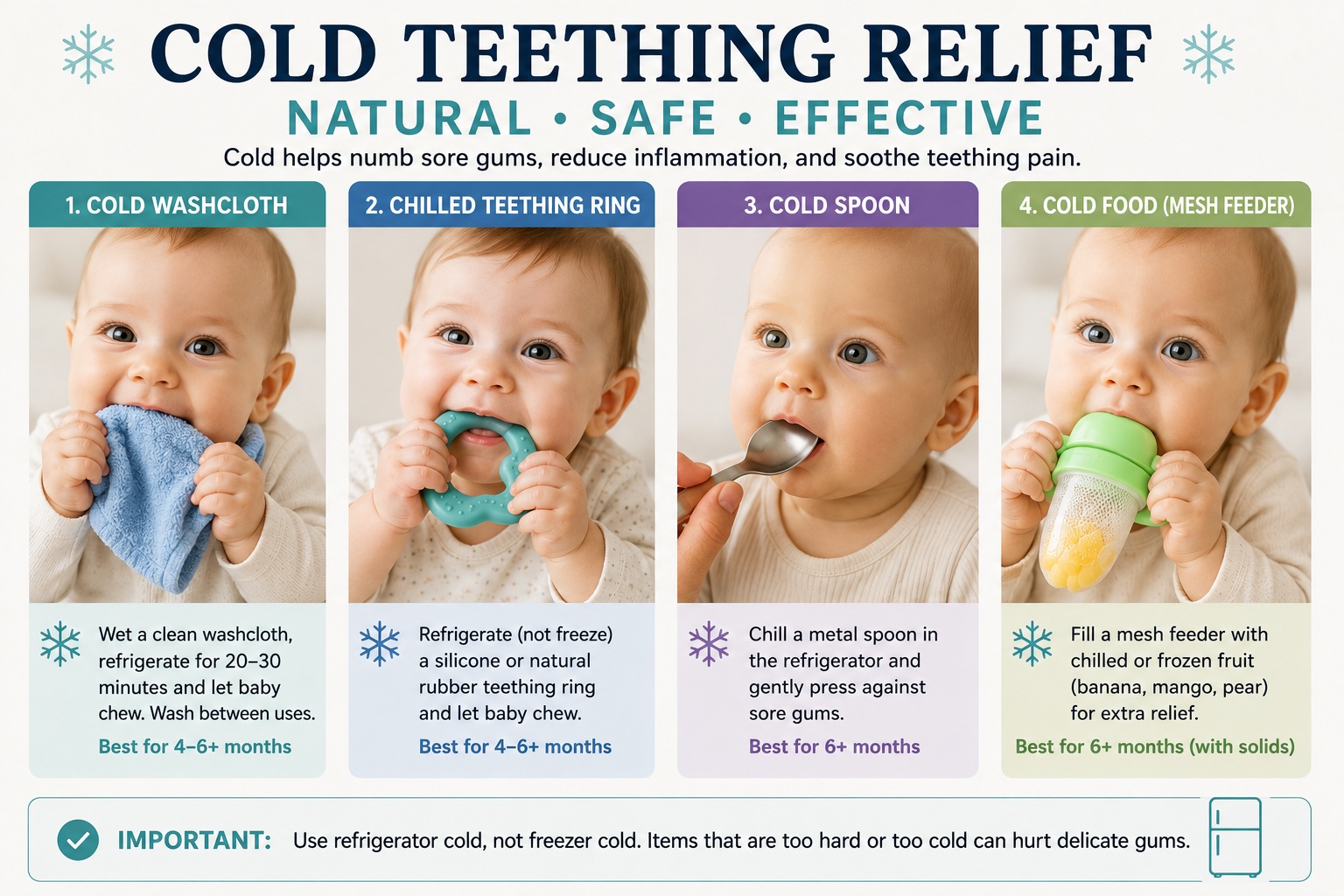
Cold washcloth. Wet a clean washcloth, wring it out, fold it, and put it in the refrigerator (not the freezer) for 20–30 minutes. Give it to your baby to chew on. The texture and cold together provide real relief. This works from around 4–6 months onward. Wash it between uses.
Chilled teething ring. Silicone or natural rubber teething rings kept in the refrigerator (not freezer) are one of the most reliable options. The cold dulls the pain and the pressure feels good against sore gums. Look for one-piece designs — rings with liquid inside can leak or crack.
Cold spoon. A metal spoon kept in the refrigerator and pressed gently against the gums works surprisingly well. Metal holds cold longer than silicone and some babies respond better to the firmer pressure.
One important rule: refrigerator cold, not freezer cold. Frozen items get hard enough to bruise gum tissue and cold enough to damage the delicate skin inside a baby’s mouth. If it’s too cold for you to hold comfortably, it’s too cold for your baby’s gums.
Pressure and Gum Massage
Counter-pressure works on the same principle as rubbing a banged elbow — it interrupts the pain signal and gives the nervous system something else to focus on.
Clean finger massage. Wash your hands thoroughly, then use a clean finger to apply gentle but firm pressure to the sore area of the gum. Move in small circles. Most babies find this immediately soothing. It works best when you can identify exactly which area is most tender — look for swelling or redness along the gum line.
Teething rings and toys. These let babies apply their own pressure whenever they need it, which is more practical than constant finger massage. The key is choosing safe ones:
- Silicone: Easy to clean, durable, holds cold well, generally BPA-free. The most practical everyday option.
- Natural rubber: Softer than silicone, feels more organic, a good option for babies who prefer a softer texture. Check that it’s 100% natural rubber with no added fillers.
- Avoid: Liquid-filled rings (can leak), rings with small parts that could detach, cheap plastic rings without BPA-free labeling, painted or decorated rings where the coating could chip off.
Mesh feeders with cold food. For babies who’ve started solids, a mesh feeder filled with cold banana, mango, or pear and kept briefly in the fridge gives them something to gnaw on safely. The mesh prevents large pieces from becoming a choking hazard while still delivering cold and pressure right to the gums.
Chilled Foods for Babies Who Have Started Solids
Once your baby is eating solids — typically from around 6 months — chilled foods add another tool to the kit.
Cold purees. A spoonful of chilled apple puree, pear puree, or yogurt goes down well and soothes sore gums on the way. Keep a small portion in the fridge rather than serving it straight from room temperature.
Chilled cucumber or carrot sticks. For babies old enough to hold food and under close supervision — a chilled thick stick of cucumber or peeled carrot can be satisfying to gnaw on. Stay close. These are not appropriate for babies who have teeth that could bite off a piece.
Frozen fruit in a mesh feeder. A small piece of frozen banana or mango inside a mesh feeder gives more intense cold relief than just refrigerated food. The mesh does the safety work — babies can gnaw without getting a piece they could choke on.
What to avoid: Whole grapes, hard raw vegetables that could snap off, anything small and round, and any food your baby hasn’t been introduced to yet.
Distraction and Comfort
It sounds too simple, but distraction genuinely works — and it’s often underestimated by parents looking for something more “medical.”
Pain perception in babies (and adults) is heavily influenced by attention. When a baby is engaged — being carried, interacting with a parent, playing — the pain signal doesn’t dominate. When they’re bored, tired, or alone, it takes over completely.
Skin-to-skin contact and carrying. Being held, especially skin-to-skin, releases oxytocin in both parent and baby. It genuinely reduces pain perception. A baby who was inconsolable in a cot often calms quickly when picked up — not because you’ve fixed anything, but because being held changes how they experience discomfort.
Breastfeeding. For breastfeeding mothers, nursing provides comfort, distraction, and a small amount of pain relief through the sucking action and closeness. Some babies breastfeed more during teething. Some refuse to because the suction pressure is uncomfortable on sore gums — both responses are normal.
Extra engagement. A walk outside, a new toy, a bath, or simply focused one-on-one time can all interrupt a teething fuss more effectively than any product. It won’t stop the teething, but it changes the experience of it.
Chamomile — The Most Cited Herbal Remedy
Chamomile comes up in almost every discussion of natural teething remedies. It has mild anti-inflammatory and calming properties, and there’s a reasonable traditional basis for its use — though clinical evidence specifically in teething babies is limited.
Chamomile tea (for babies over 6 months). A small amount of cooled chamomile tea — a teaspoon or two — can be offered to babies over 6 months. You can also dip a clean cloth in cooled chamomile tea and let them chew on it. The combination of the mild anti-inflammatory compounds and the cold cloth gives you two benefits at once.
Under 6 months, avoid chamomile tea — babies this young should have breast milk or formula only.
Chamomile-based teething products. Several natural teething gels and drops contain chamomile as a primary ingredient. These are generally considered safer than benzocaine-based products, but check the full ingredient list carefully. Avoid any product containing alcohol, belladonna, or benzocaine regardless of how “natural” the marketing sounds.
Safety note: Chamomile is in the same plant family as ragweed. If there’s a family history of ragweed allergy or hay fever, introduce chamomile cautiously and watch for any reaction.
Natural Teething Remedies to Avoid
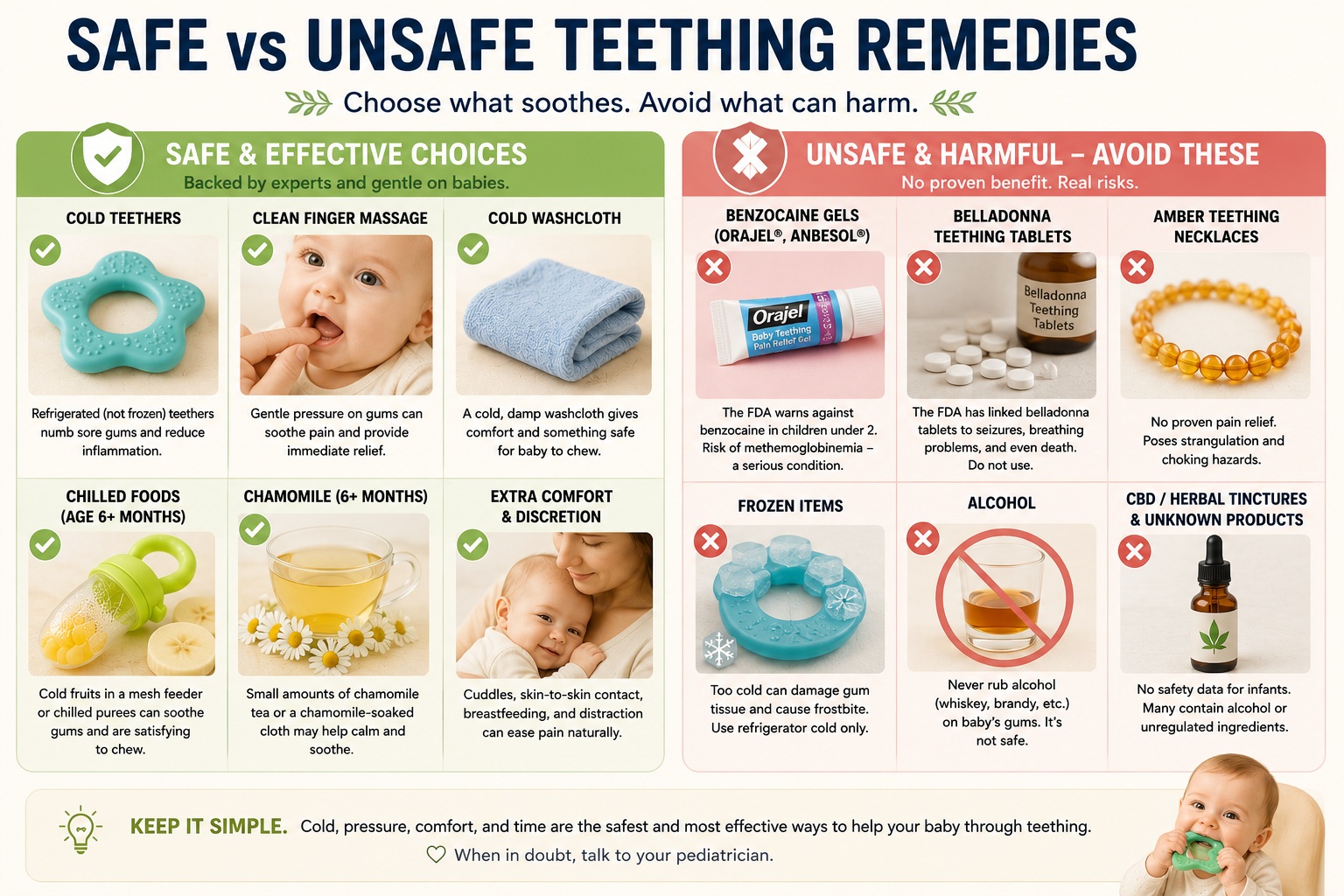
This section matters as much as everything above it. Several widely used teething products carry real risks.
Teething gels with benzocaine. The FDA has warned against using benzocaine products (Orajel, Anbesol, and similar) in children under 2. Benzocaine can cause methemoglobinemia — a rare but serious condition that reduces the blood’s ability to carry oxygen. It can be life-threatening. Avoid these products entirely in babies and toddlers.
Belladonna teething tablets. The FDA has issued multiple warnings about homeopathic teething tablets containing belladonna — a plant that contains atropine and other toxic compounds. Lab testing found inconsistent and sometimes dangerous levels of belladonna alkaloids in these products. Seizures and deaths have been reported. Do not use them.
Amber teething necklaces. There is no clinical evidence that amber necklaces relieve teething pain. The proposed mechanism — succinic acid released from the amber and absorbed through the skin — has not been demonstrated in any peer-reviewed research. More importantly, these necklaces pose a real strangulation risk and a choking risk if a bead detaches. The American Academy of Pediatrics advises against them. Don’t use them, even supervised.
Frozen items. Frozen teething rings, frozen washcloths, and frozen food directly on gums can cause frostbite on delicate gum tissue. Refrigerator cold only.
Alcohol. Rubbing whiskey or brandy on a baby’s gums is an old folk remedy that is never safe. Babies metabolize alcohol very differently from adults — even a small amount can cause dangerously low blood sugar and other serious effects.
CBD and herbal tinctures. There is no safety data on CBD use in infants. Many herbal tinctures contain alcohol as a base. Neither has been tested for infant safety and neither should be used.
What About Teething Toys — What’s Actually Safe?
The teething toy market is enormous and the quality varies wildly. Here’s a simple guide to choosing well.
What to look for:
- One-piece silicone or natural rubber construction — no small parts that could detach
- BPA-free, phthalate-free, PVC-free labeling
- Simple design — easier to clean and less likely to have hidden areas where bacteria collect
- Size appropriate for your baby — large enough that it can’t be fully inserted into the mouth
What to avoid:
- Liquid-filled rings — the liquid can become contaminated and the ring can crack
- Rings with attachments — ribbons, clips, decorative elements that could detach
- Painted or coated surfaces — paint can chip and be swallowed
- Very cheap, unbranded products — these often don’t meet safety standards
Cleaning: Wash teething toys with warm soapy water after each use. Most silicone toys can go in the dishwasher on the top rack. Don’t boil natural rubber toys — high heat degrades the rubber and can cause it to crack.
When to See a Doctor
Most teething is uncomfortable but manageable. A few signs mean it’s time to pick up the phone.
See a doctor if:
- Your baby has a temperature of 38°C (100.4°F) or above — this is not teething
- Symptoms last more than a few days without any improvement
- Your baby is refusing all fluids — dehydration risk
- There’s significant swelling, redness, or discharge from the gum area
- Your baby seems unusually unwell beyond just irritable
- You’re not sure whether what you’re seeing is teething or something else
Ear infections, colds, and other illnesses often coincide with teething simply because of timing — babies get more illnesses as they get older and start exploring the world. A real fever always needs evaluation.
Frequently Asked Questions
What is the safest natural teething remedy?
Cold and pressure — a chilled washcloth or refrigerated silicone teething ring. Both are safe from around 4–6 months, cost almost nothing, and have the best evidence behind them. Start there before trying anything else.
Can I use clove oil for teething?
No. Clove oil contains eugenol, which is too concentrated for infant use and can cause irritation and damage to gum tissue. Even diluted, clove oil is not recommended for babies. The adult dental use of clove oil doesn’t translate safely to infants.
How long does teething pain last?
Each tooth typically causes the most discomfort in the days just before it breaks through the gum — usually 3–5 days. The pain generally eases once the tooth has emerged. Since babies get 20 primary teeth over 2–3 years, teething is an ongoing process rather than a single event.
Do amber teething necklaces work?
No — there’s no evidence they do, and they carry real safety risks. The AAP advises against them. The supposed mechanism hasn’t been demonstrated in any clinical research. Skip them.
Is it safe to rub whiskey on baby’s gums?
No. Alcohol is never safe for infants. Even a tiny amount can cause hypoglycemia (dangerously low blood sugar) and other serious effects. This is one folk remedy that should be left firmly in the past.
Final Thoughts
Teething is genuinely hard — on babies and on the parents watching them struggle. But the most effective tools are also the safest and simplest: cold, pressure, distraction, and comfort.
A chilled washcloth and some extra cuddles will outperform most of what’s marketed to parents in the teething aisle. And avoiding the unsafe options — benzocaine gels, belladonna tablets, amber necklaces — is just as important as knowing what to use.
Every baby gets through teething. It doesn’t feel that way at 3am, but they do.
This article is for informational purposes only and does not constitute medical advice. Always consult your pediatrician if you have concerns about your baby’s health or symptoms.