This post contains affiliate links. If you buy through our links we may earn a small commission — at no extra cost to you. This never influences our recommendations.
This article is for informational purposes only and does not constitute medical advice. Sun protection is a genuine skin health matter. Consult a dermatologist for personalised guidance, particularly if you have a history of skin cancer or a photosensitive skin condition.
What “Natural Sunscreen” Actually Means
The phrase “natural sunscreen” is everywhere — and largely unregulated. Any brand can print it on packaging without meeting a defined standard. So before recommending anything, it’s worth being precise about what the term should mean.
In practice, natural sunscreen refers to mineral sunscreen — sunscreen that uses zinc oxide or titanium dioxide as the active UV-blocking ingredient. These are physical minerals. They sit on top of the skin and reflect UV light before it reaches skin cells. They don’t absorb into the body in any meaningful quantity. They’re the two active ingredients the FDA has formally classified as safe and effective.
What they’re contrasted against is chemical sunscreen — using synthetic organic compounds like oxybenzone, avobenzone, octinoxate, and octocrylene that absorb UV radiation and convert it to heat. These are absorbed into the upper layers of skin — and, as research has established, into the bloodstream.
The reason people seek out natural sunscreen isn’t paranoia. There’s genuine regulatory and scientific context behind the preference for mineral formulas. The next section covers that honestly, including the things the natural sunscreen conversation often gets wrong.
Mineral vs. Chemical Sunscreen — The Honest Science
The FDA’s GRASE classification
In its sunscreen rulemaking, the FDA classified only zinc oxide and titanium dioxide as “generally recognized as safe and effective” (GRASE). The 12 chemical UV filters — including oxybenzone and avobenzone — remain under review. The FDA has requested more safety data before extending the same classification to chemical filters. This doesn’t mean oxybenzone is dangerous — it means the safety data isn’t yet sufficient for the FDA to formally certify it as it has certified zinc oxide.
The JAMA absorption study
A 2019 randomised clinical trial published in JAMA found that four chemical UV filters — avobenzone, oxybenzone, octocrylene, and ecamsule — entered blood plasma above the FDA’s threshold for safety investigation after a single day of standard sunscreen application. Zinc oxide and titanium dioxide are not absorbed into the bloodstream in any meaningful quantity — they stay where you put them.
The oxybenzone concern
The Environmental Working Group (EWG) flags oxybenzone as a potential endocrine disruptor, detected in blood, urine, and breast milk. The human health significance at typical sunscreen doses is genuinely uncertain. But for people who prefer to minimise systemic exposure to compounds with unresolved safety profiles — particularly for children, during pregnancy, or for daily use over years — the preference for mineral sunscreen is evidence-adjacent rather than evidence-free.
The essential caveat
None of this is an argument to wear less sunscreen. The documented harms of inadequate sun protection dramatically outweigh any theoretical concern about chemical filters. The worst sunscreen is the one you don’t apply. The argument is simply: when choosing between formulations with equivalent SPF, mineral is the more cautious choice.
What Makes a Sunscreen Truly Natural? A Buyer’s Checklist
Active ingredient: zinc oxide (non-nano) — The gold standard. The only single ingredient that provides true broad-spectrum UVA and UVB protection. “Non-nano” means the particles are large enough not to penetrate skin or be ingested by marine organisms.
Broad spectrum confirmed — An FDA label requirement confirming protection against both UVA (deeper damage, ageing) and UVB (burning, surface damage). Always verify — SPF alone only guarantees UVB protection.
SPF appropriate for your use — SPF 30 blocks approximately 97% of UVB rays; SPF 50 blocks approximately 98%. SPF 30 is appropriate for daily incidental exposure. SPF 50 is the better choice for extended time outdoors, water activities, or high-UV environments.
Water resistance for your activities — 40 minutes or 80 minutes (the only two FDA-permitted claims). For swimming or sweating, choose 80-minute water resistance and reapply after that window.
Short, recognisable ingredient list — The cleanest formulas use plant oils, waxes, and vitamin E as their base. Longer ingredient lists with synthetic emollients, preservatives, and fragrance move further from what most people mean by “natural.”
Certifications that mean something — EWG Verified (independent ingredient screening), USDA Organic (organic content of non-active ingredients), Leaping Bunny / certified cruelty-free, and Hawaii Reef Act 104 compliant (the strictest reef-safety standard in US law).
The Best Natural Sunscreens Right Now — Verified Amazon Picks
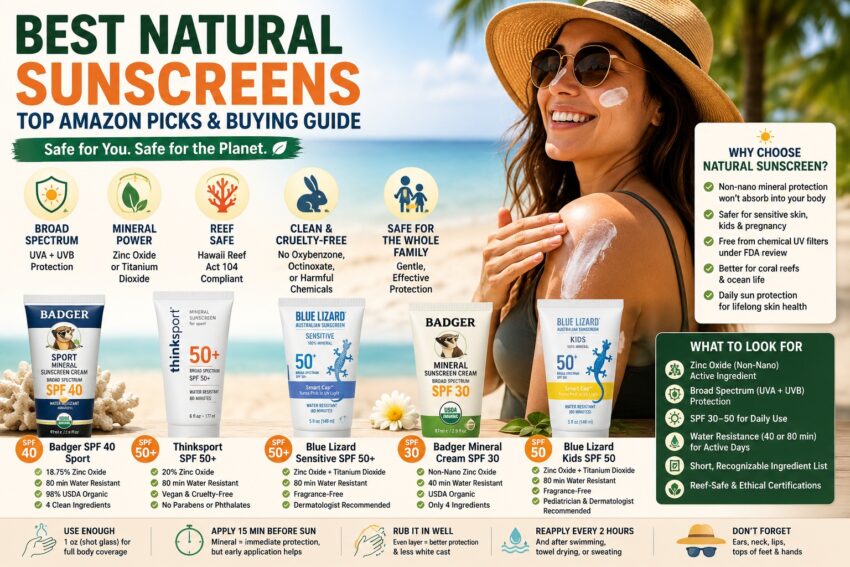
All five products below use zinc oxide as the active ingredient, are free of oxybenzone and octinoxate, and are confirmed in stock on Amazon.
| Product | SPF | Active | Water Resist | Key Credentials | Price |
|---|---|---|---|---|---|
| Badger SPF 40 Sport | 40 | 18.75% ZnO | 80 min | USDA Organic, Reef Act 104 | ~$18 (2-pack) |
| Thinksport SPF 50+ | 50+ | 20% ZnO | 80 min | Leaping Bunny, vegan | ~$20 |
| Blue Lizard Sensitive SPF 50+ | 50+ | ZnO + TiO2 | 80 min | Fragrance-free, dermatologist rec | ~$16 |
| Badger Mineral Cream SPF 30 | 30 | non-nano ZnO | 40 min | USDA Organic, 4 ingredients | ~$14 |
| Blue Lizard Kids SPF 50 | 50 | ZnO + TiO2 | 80 min | Fragrance-free, paraben-free | ~$16 |
Badger SPF 40 Sport Mineral Sunscreen — Best Overall
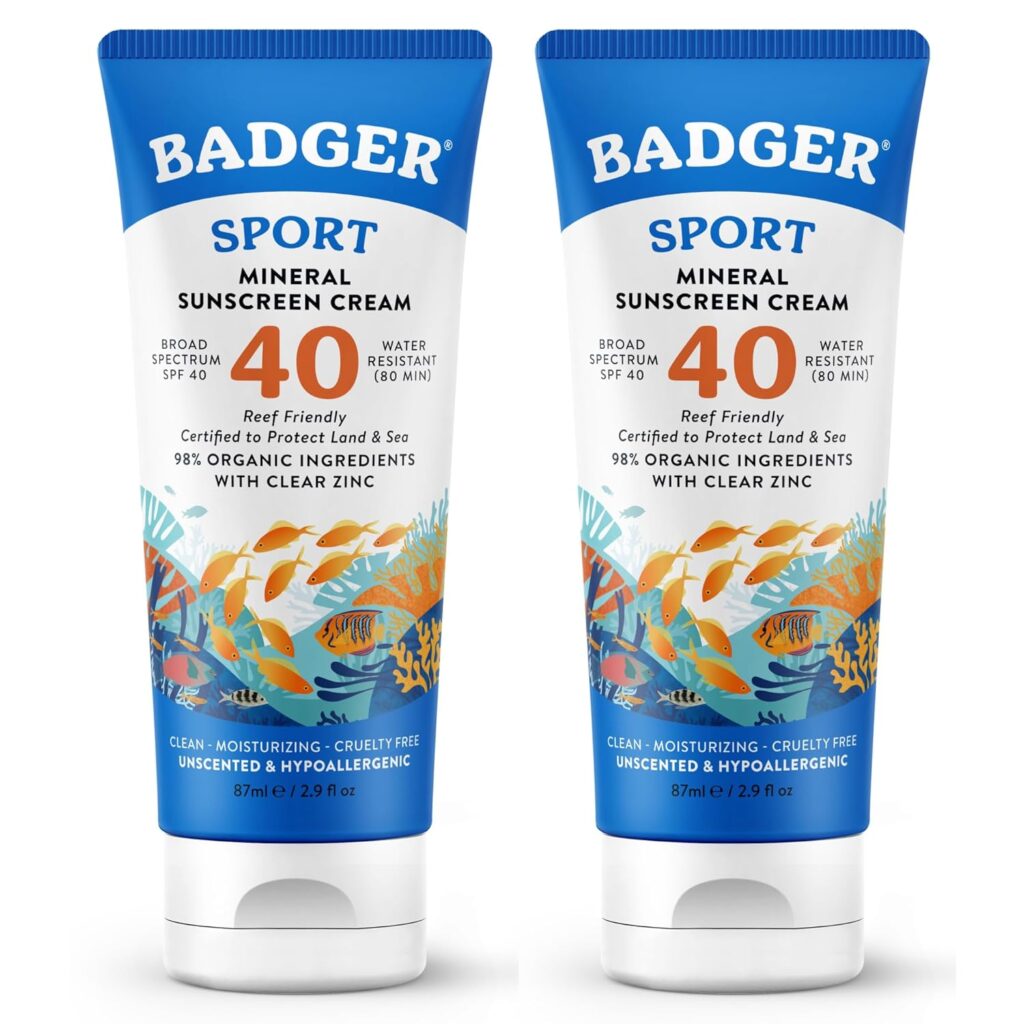
Badger SPF 40 Sport is the mineral sunscreen that consistently performs best in independent testing, has the shortest ingredient list of any product in its category, and is made by a company whose transparency and values match what natural sunscreen buyers are actually looking for.
The ingredient list is four items long: uncoated clear zinc oxide (18.75%), organic sunflower oil, organic beeswax, and sunflower vitamin E. No synthetic emollients, no preservatives, no fragrance, no filler. 98% certified organic, USDA Organic certified, and compliant with Hawaii Reef Act 104. Badger is a family-owned B Corp based in New Hampshire with a publicly documented supply chain.
The Sport formula is built for active use — 80-minute water and sweat resistance. Despite the high zinc concentration, independent testing consistently rates it as one of the best-applying mineral sunscreens when applied in the right quantity and rubbed in properly.
Pros: Fewest ingredients of any pick (4 total), 98% USDA Organic, Hawaii Reef Act 104 compliant, B Corp manufacturer, excellent independent test ratings, 80-min water resistance, unscented
Cons: Not vegan (beeswax), requires thorough rubbing-in, some white cast, premium price per ounce
Best for: Most people — the default recommendation for anyone who wants the cleanest, most transparent mineral sunscreen formulation
Thinksport SPF 50+ Mineral Sunscreen — Best Vegan Option
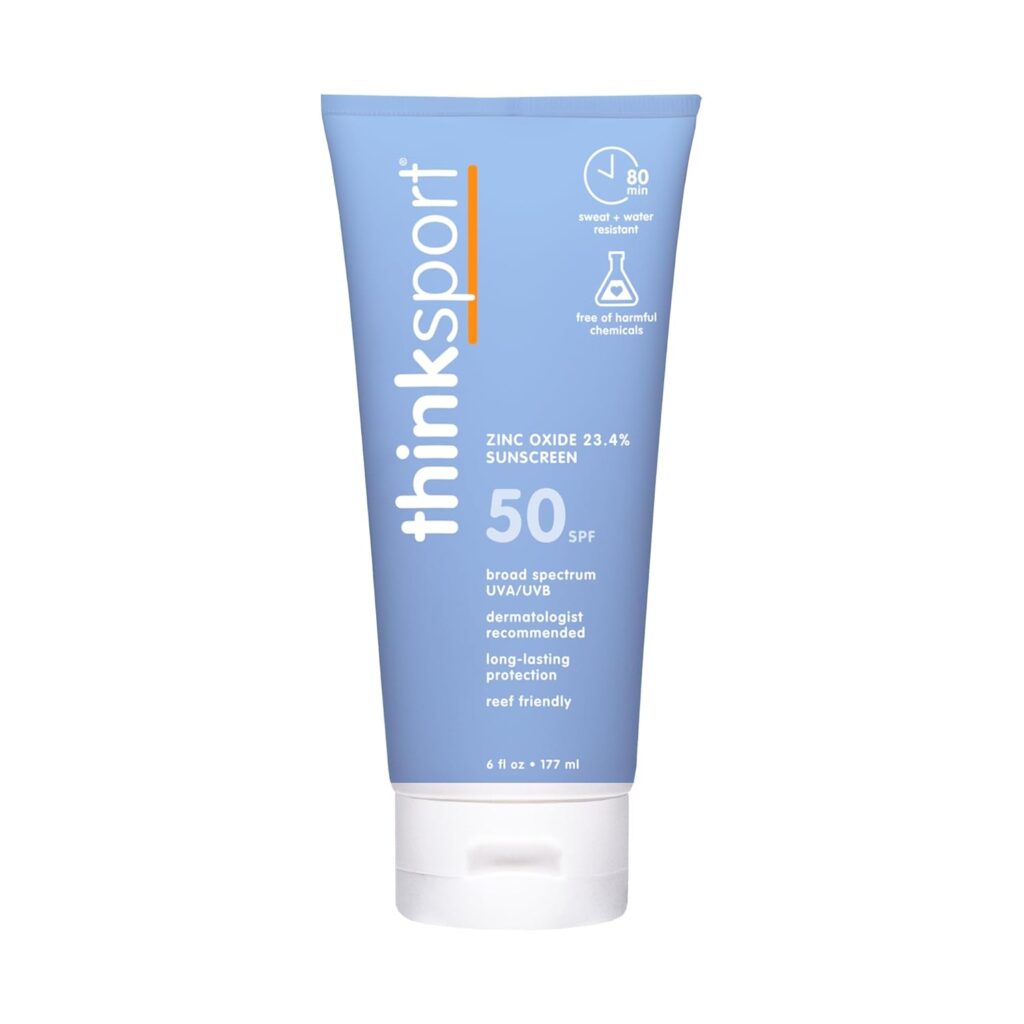
Thinksport SPF 50+ is the vegan alternative for anyone for whom Badger’s beeswax base is a dealbreaker — and it’s a legitimate contender in its own right, not a compromise pick. It uses 20% non-nano zinc oxide, is Leaping Bunny certified cruelty-free, reef-safe, and free of parabens, phthalates, oxybenzone, and octinoxate.
The SPF 50+ rating and 80-minute water resistance make it appropriate for extended outdoor use and high-UV environments. The 6 fl oz format is the largest in our picks — the best per-ounce value for whole-family daily use. Thinksport was one of the first sunscreens to pass Whole Foods Premium Body Care standards and has a strong track record in the natural products space.
Pros: Vegan, SPF 50+, 20% non-nano zinc, Leaping Bunny certified, 80-min water resistance, 6oz value size, no parabens or phthalates
Cons: Ingredient list longer and less purely organic than Badger, some white cast
Best for: Vegan buyers, families wanting the largest bottle for everyday use, anyone prioritising highest SPF in a mineral formula
Blue Lizard Sensitive Mineral SPF 50+ — Best for Sensitive Skin
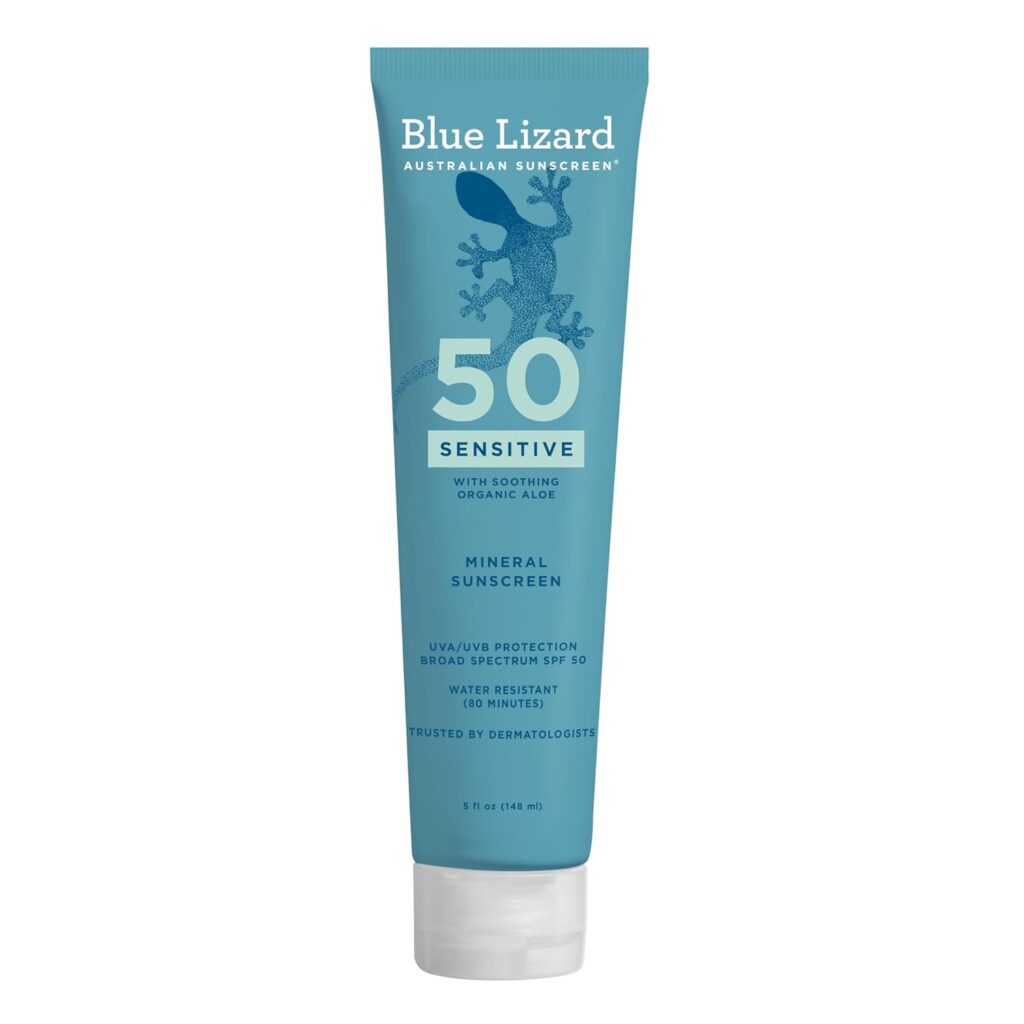
If you have reactive skin — eczema, rosacea, contact dermatitis, fragrance sensitivity — Blue Lizard Sensitive is the pick, and it’s not close. Blue Lizard is an Australian-developed brand shaped by the world’s most demanding sun protection standards. The Sensitive formula is 100% mineral (zinc oxide and titanium dioxide), completely fragrance-free, paraben-free, and infused with organic aloe vera for soothing hydration.
The Smart Cap turns pink when exposed to UV light — a genuinely useful visual reminder on days when sun strength isn’t obvious. Dermatologists commonly recommend Blue Lizard Sensitive because its gentleness makes it appropriate for conditions where most sunscreens cause flares.
Pros: 100% mineral, completely fragrance-free, paraben-free, aloe-infused, SPF 50+, 80-min water resistance, dermatologist-recommended, UV-detecting Smart Cap
Cons: Contains titanium dioxide (slightly less UVA breadth than zinc-only formulas), some synthetic stabilisers in the base
Best for: Eczema, rosacea, contact dermatitis, fragrance sensitivity — anyone who has reacted to other sunscreens
Badger Mineral Sunscreen Cream SPF 30 — Best Minimal Formula / Travel
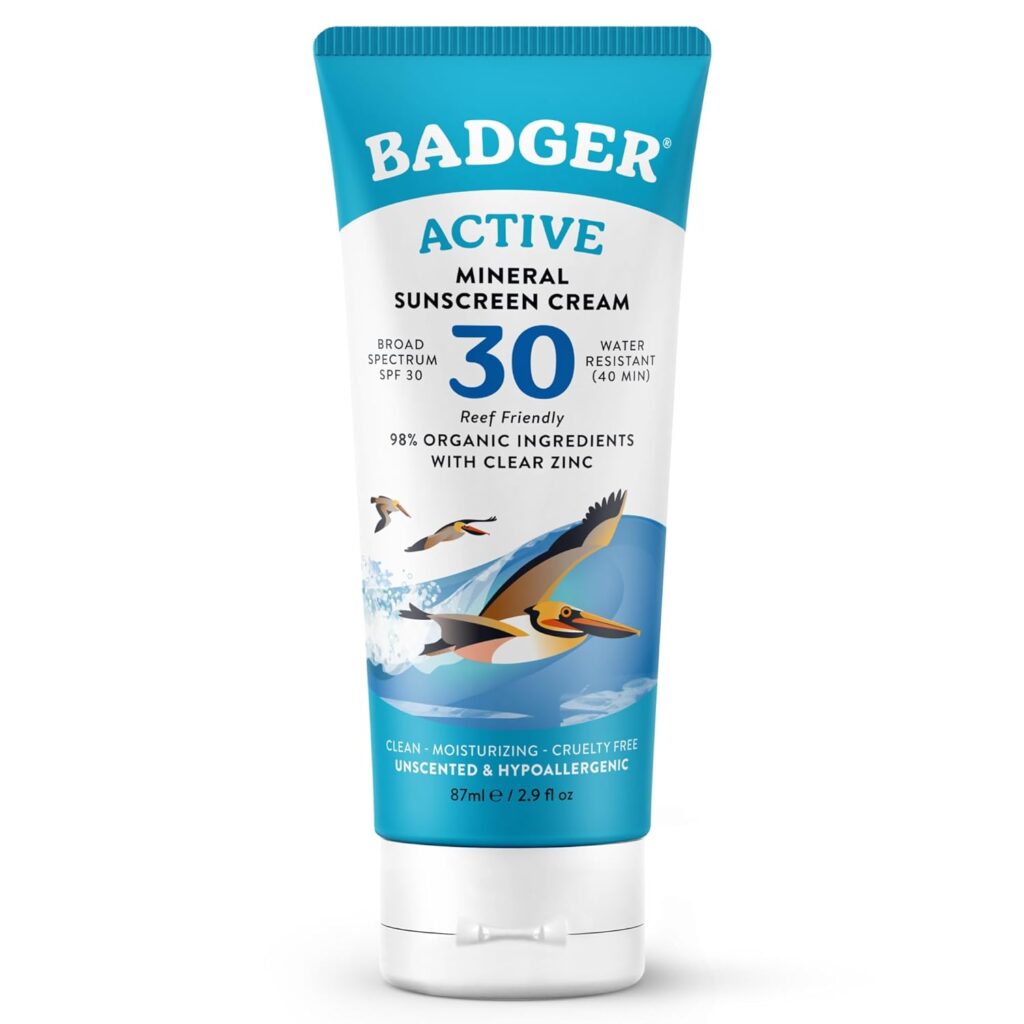
The SPF 30 Badger cream applies the same four-ingredient philosophy as the Sport formula in a smaller, more affordable travel-friendly tube. Same zinc oxide base, same USDA Organic certification. SPF 30 at 40-minute water resistance — appropriate for daily incidental sun exposure rather than extended outdoor activity.
This is the tube that belongs in a bag, a desk drawer, a glove compartment. Daily incidental protection is where most cumulative UV damage accumulates — commuting, running errands, sitting near windows — and a simple, genuinely clean formula you’ll actually use daily is more valuable than an elaborate sport formula you apply twice a year.
Pros: Same 4-ingredient Badger formula, USDA Organic, travel-friendly, lower price, genuinely clean for daily use, unscented
Cons: SPF 30 (adequate daily, not optimal for extended beach or sport), 40-min water resistance, not vegan
Best for: Daily incidental protection, travel, keeping in a bag or car, minimalist-ingredient seekers
Blue Lizard Kids Mineral SPF 50 — Best for Children
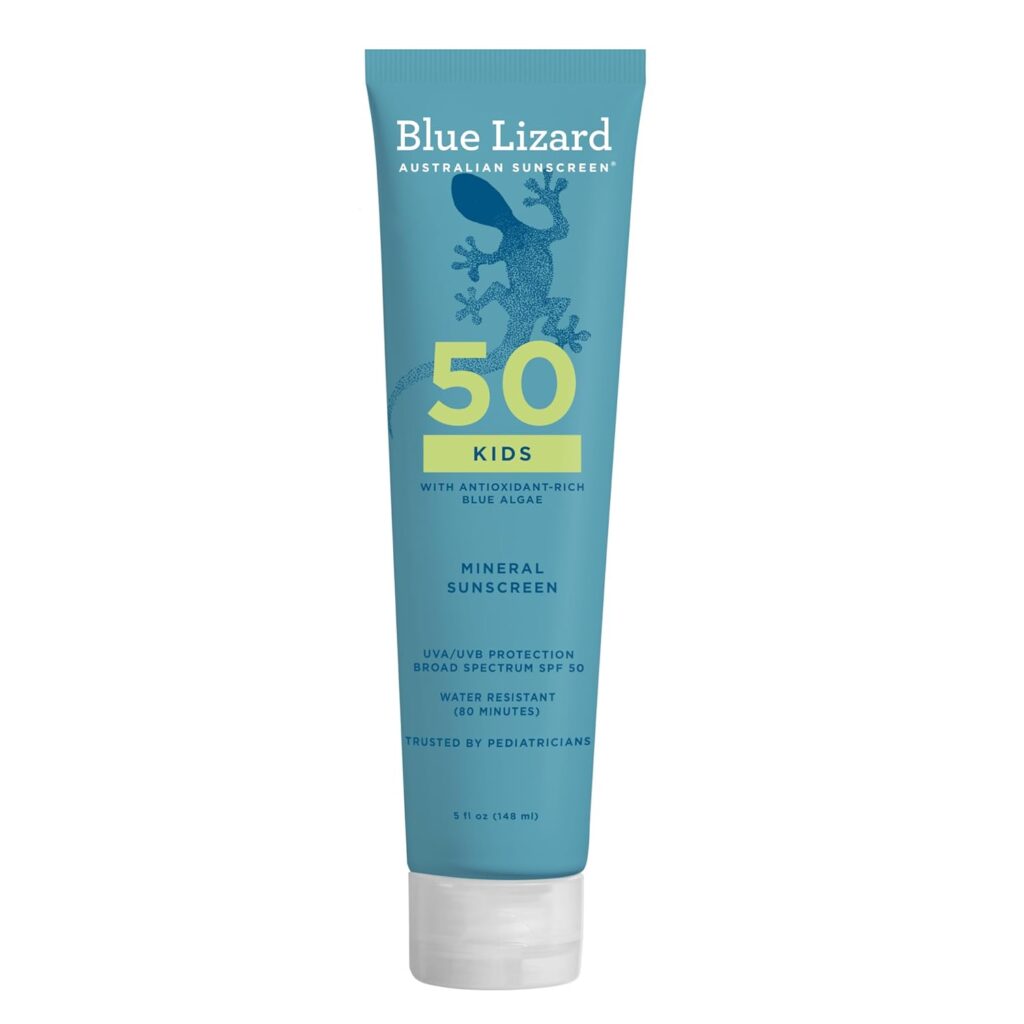
The case for mineral-only sunscreen is strongest for children. Children’s skin is thinner and more permeable — the systemic absorption of chemical UV filters documented in the JAMA study is more concerning in developing bodies. Blue Lizard Kids uses 100% mineral formulation — fragrance-free, paraben-free, SPF 50, 80-minute water resistance — in a formula specifically appropriate for young sensitive skin. The Smart Cap turns pink in UV, which children engage with as a visual cue rather than a parental battle.
Pros: 100% mineral, fragrance-free, paraben-free, SPF 50, 80-min water resistance, gentle for children’s skin, UV-detecting Smart Cap, won’t sting eyes
Cons: White cast (harder to minimise on active, wriggling children)
Best for: Children over 6 months, families wanting one gentle mineral sunscreen for the whole family
How to Apply Natural Sunscreen So It Actually Works
Use enough. The FDA’s recommended quantity is 2mg per square centimetre — approximately 1 oz (a shot glass full) for full-body coverage. Studies consistently show people apply 25–50% of the required amount, receiving only a fraction of the labelled SPF protection. Don’t be shy with it.
Apply 15 minutes before going out. Mineral sunscreen provides immediate protection on application (unlike chemical sunscreen, which needs 20 minutes), but applying early allows it to settle into an even layer before sun exposure begins.
Rub it in properly. Mineral sunscreen needs more thorough rubbing-in than chemical sunscreen. Work it into the skin until the white cast diminishes. A thin, well-distributed layer offers better protection — and looks better — than a thick, patchy one.
Don’t miss the obvious gaps. Ears, back of the neck, tops of feet, hairline, and lips. Add an SPF lip balm to your routine. These are consistent sites of cumulative sun damage precisely because they get missed.
Reapply every two hours. And after swimming or sweating — towel-drying physically removes sunscreen. The two-hour rule applies even on cloudy days: up to 80% of UV radiation penetrates cloud cover.
Natural Sunscreen for Specific Skin Types
Oily or acne-prone skin: Look for lighter mineral formulas. Thinksport’s base tends to feel lighter than Badger’s oil-and-wax formula, making it more comfortable for oily skin. Zinc oxide itself has mild anti-inflammatory properties that can benefit acne-prone skin.
Dry skin: Badger’s sunflower oil base doubles as a moisturiser — a genuine benefit. Blue Lizard Sensitive with aloe vera also provides hydration alongside protection.
Darker skin tones: The white cast from zinc oxide is more noticeable on deeper skin tones — the honest cosmetic trade-off. Tinted mineral sunscreens with iron oxides eliminate the cast while improving UVA protection. Brands like EltaMD, Black Girl Sunscreen (mineral version), and Colorescience offer tinted mineral options worth considering.
Mature skin: Mineral sunscreen is ideal — zinc oxide’s anti-inflammatory properties don’t aggravate mature skin, and the oil-based Badger formulas provide hydration alongside protection. SPF 50 is worth choosing for mature skin to maximise protection against UV-driven ageing.
The Reef-Safe Dimension — Why It Matters Beyond the Beach
Oxybenzone and octinoxate are documented to cause coral bleaching and reef toxicity at extremely low concentrations. Hawaii’s 2021 Reef Act 104 bans both compounds. Key West, the U.S. Virgin Islands, Palau, Aruba, and Bonaire have enacted similar protections. The science on coral toxicity is among the most robust in the chemical sunscreen literature.
The issue extends inland. Oxybenzone and octinoxate enter waterways through ordinary showering — you don’t have to be at a reef to contribute. Every time these compounds are washed off, they enter water treatment systems (which don’t remove them) and eventually reach freshwater and marine ecosystems. Mineral sunscreen with non-nano zinc oxide avoids this entirely.
“Non-nano” matters specifically here: nano-sized zinc particles are small enough to be ingested by coral polyps. All products recommended in this article use non-nano zinc oxide.
Myths About Natural Sunscreen Worth Clearing Up
“DIY sunscreen with coconut oil or raspberry seed oil works.” This is genuinely dangerous misinformation. Coconut oil provides approximately SPF 4–8 at most under optimistic laboratory conditions. There is no way to verify the SPF of a homemade formulation. Using a DIY “natural” sunscreen in place of a properly tested and rated product exposes you to significant UV damage — this is a safety risk, not a natural health practice.
“Natural sunscreen doesn’t protect as well.” False. Zinc oxide is the broadest-spectrum UV blocker available in a single active ingredient. Applied correctly and in adequate quantity, mineral sunscreen provides protection equivalent to or better than chemical alternatives at the same SPF.
“You need SPF 100 for real protection.” No. SPF 50 blocks approximately 98% of UVB. SPF 100 blocks approximately 99%. The gain above SPF 50 is negligible, and higher SPF numbers encourage less frequent reapplication. Correct application of SPF 30–50 outperforms incorrect application of SPF 100.
“Darker skin doesn’t need sunscreen.” False. While melanin provides some natural protection, all skin tones are susceptible to UV damage, premature ageing, and skin cancer. Tinted mineral formulas solve the white cast challenge on deeper skin tones.
When to See a Dermatologist
Sunscreen is an important part of skin health — not a replacement for professional skin monitoring. See a dermatologist if you notice any of the following:
- A new mole or skin lesion, or a change in an existing mole (size, shape, colour, or border definition)
- A spot that bleeds spontaneously, itches persistently, crusts over, or doesn’t heal within a few weeks
- A mole meeting the ABCDE criteria: Asymmetry, irregular Border, multiple Colours, Diameter larger than a pencil eraser, or Evolving over time
- A personal or family history of melanoma or other skin cancers
- Significant sun exposure history — particularly blistering sunburns in childhood, a documented risk factor for later melanoma
Annual skin checks are recommended for higher-risk individuals. Sunscreen is prevention — not screening or treatment.
Frequently Asked Questions
What is the best natural sunscreen overall?
For most people, Badger SPF 40 Sport — four ingredients, 98% organic, USDA certified, Hawaii Reef Act 104 compliant, and consistently top-rated in independent testing. For vegan buyers, Thinksport SPF 50+. For sensitive or reactive skin, Blue Lizard Sensitive. The right answer depends on your skin type and priorities.
Is mineral sunscreen as effective as chemical sunscreen?
Yes, when applied correctly and in sufficient quantity. Zinc oxide provides broad-spectrum UVA and UVB protection equivalent to the best chemical formulas. The practical difference is application texture — mineral sunscreen requires more thorough rubbing-in — not protection level.
Does natural sunscreen leave a white cast on darker skin?
It can — this is the genuine cosmetic trade-off of zinc oxide. Thorough rubbing-in minimises it. Tinted mineral sunscreens with iron oxides eliminate it entirely while also improving UVA protection. For deeper skin tones, a tinted mineral formula is worth seeking out.
Is natural sunscreen reef-safe?
All five products recommended here are. Reef-safe means free of oxybenzone and octinoxate — the compounds with documented coral toxicity. Non-nano zinc oxide, the active ingredient in all five picks, has no documented harm to coral reef ecosystems.
Should I use SPF 30 or SPF 50?
SPF 30 for daily incidental use (commuting, errands, indoor-to-outdoor transitions). SPF 50 for extended time outdoors, water activities, beach days, fair or sun-sensitive skin, or high-altitude environments. Correct and consistent application matters more than the SPF number.
Why does mineral sunscreen matter more for children?
Children’s skin is thinner and more permeable, making the systemic absorption of chemical UV filters more concerning in developing bodies. Mineral sunscreen’s non-absorbed mechanism is the more cautious choice. The AAD recommends keeping babies under 6 months out of direct sun, and using mineral sunscreen for children over 6 months.
Final Verdict
| Your Situation | Best Pick |
|---|---|
| Best overall | Badger SPF 40 Sport |
| Best vegan | Thinksport SPF 50+ |
| Best for sensitive skin | Blue Lizard Sensitive SPF 50+ |
| Best minimal formula / travel | Badger Mineral Cream SPF 30 |
| Best for children | Blue Lizard Kids SPF 50 |
| Best for oily skin | Thinksport SPF 50+ |
| Best for dry skin | Badger SPF 40 Sport |
| Best for beach and active use | Badger SPF 40 Sport or Thinksport SPF 50+ |
The natural sunscreen conversation is worth having — the science behind preferring mineral formulas is real, the FDA’s regulatory position is meaningful, and the reef-safe distinction matters. But the most important thing is still applying enough of whatever you choose, applying it consistently, and reapplying it every two hours.
Start with Badger SPF 40 Sport if you’re unsure where to begin. Adjust from there based on your skin type and lifestyle. All five picks above are genuinely excellent — clean formulations, honest certifications, proven protection.
This article is for informational purposes only and does not constitute medical advice. Consult a dermatologist for personalised guidance, particularly with a history of skin cancer or a photosensitive skin condition.