
Why People Look for Herbal Headache Relief
Most people reach for ibuprofen or paracetamol when a headache hits — and that’s often the right call. But there’s a growing group of people looking for something different, and usually for good reason.
Medication overuse headaches are one of the most underappreciated problems in headache medicine. Taking OTC pain relievers more than 10–15 days per month can actually cause more headaches — a cruel cycle where the treatment becomes the trigger. For people caught in that loop, reducing medication reliance is genuinely necessary, not just a lifestyle preference.
Others want to address the underlying cause rather than just blunt the pain — reducing inflammation, relieving muscle tension, or preventing migraines before they start.
Before we get into remedies — see a doctor if:
- Your headache is the worst of your life or came on suddenly like a thunderclap
- Headache is accompanied by fever, stiff neck, confusion, or vision changes
- You have a headache after a head injury
- Headaches are getting progressively worse over days or weeks
- You’re having headaches more than 15 days per month
Know Your Headache Type First
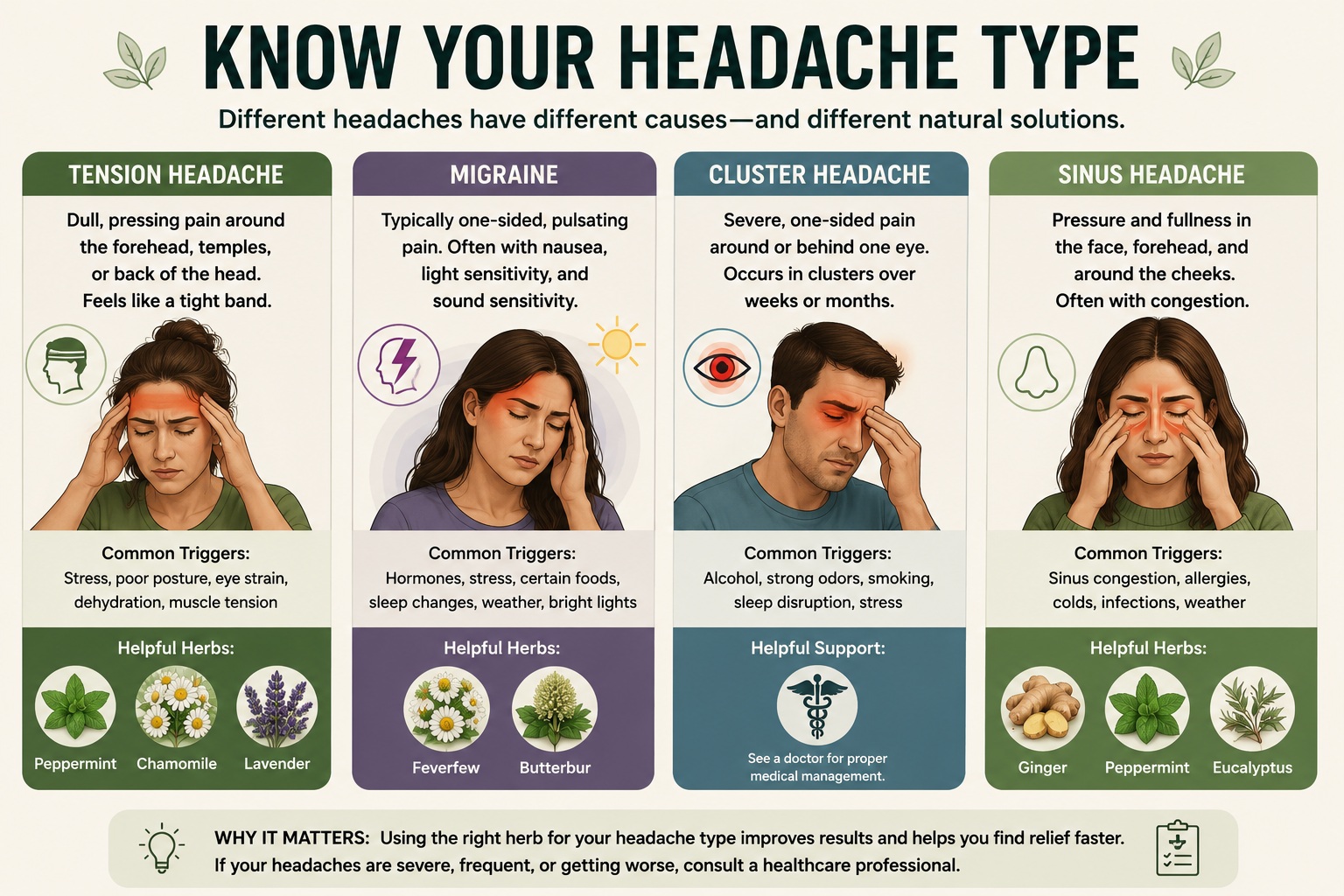
Not all headaches respond to the same remedies. Matching the herb to the headache type makes a real difference.
Tension headaches are the most common — a dull, pressing pain around the forehead, temples, or back of the head, often described as a tight band. Usually triggered by stress, poor posture, eye strain, or dehydration. Peppermint oil, chamomile, and lavender work well here.
Migraines are a different neurological condition — typically one-sided, pulsating, often accompanied by nausea, light sensitivity, and sound sensitivity. Feverfew and butterbur have the strongest evidence for migraine prevention specifically.
Cluster headaches are severe, one-sided headaches around the eye that come in clusters over weeks or months. Herbal remedies have limited evidence here — medical management is usually necessary.
Sinus headaches often come with facial pressure and nasal congestion. Ginger, peppermint, and eucalyptus (inhaled) can help address both the headache and the sinus congestion driving it. See our guide to the best herbs for sinus relief for more detail on this specific type.
The Best Herbal Remedies for Headaches
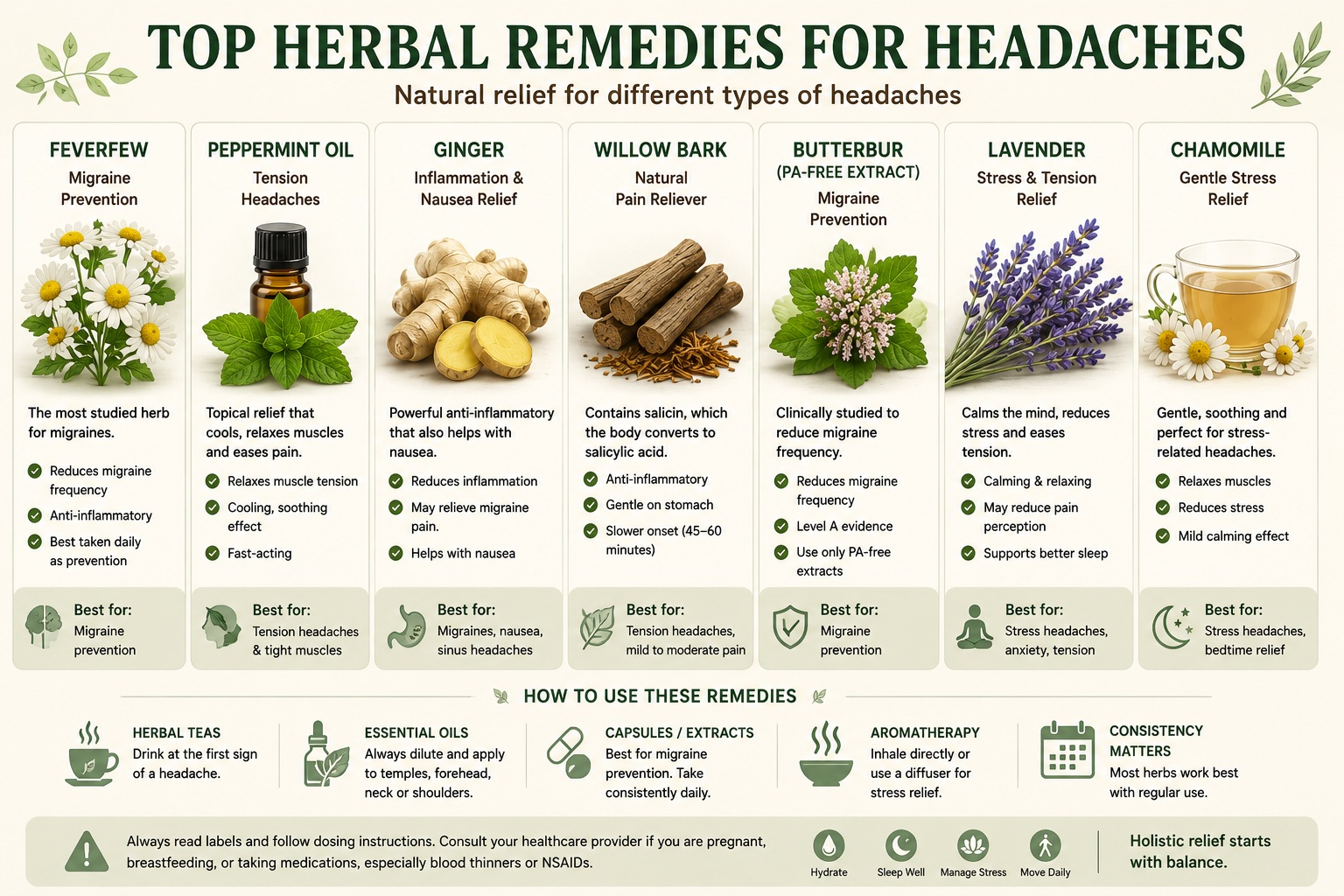
Feverfew — The Migraine Herb
Feverfew (Tanacetum parthenium) is the most studied herbal remedy for migraines and the one with the strongest clinical evidence. Multiple randomized controlled trials have found that regular feverfew supplementation reduces migraine frequency, severity, and duration compared to placebo.
Feverfew contains parthenolide, a compound that inhibits platelet aggregation, reduces the release of prostaglandins and serotonin, and blocks inflammatory pathways involved in migraine onset — the same mechanisms targeted by some conventional migraine medications.
The key word is prevention. Feverfew works best taken daily as a preventive measure — it significantly reduces how often migraines occur. It’s much less effective taken acutely during a migraine already underway.
How to use it: Standardized feverfew extract capsules (standardized to 0.2–0.35% parthenolide), 50–125mg per day. Allow 4–6 weeks of consistent use before assessing effectiveness.
Safety: Avoid during pregnancy — feverfew can stimulate uterine contractions. Don’t take alongside blood-thinning medications without medical advice. Taper off gradually rather than stopping suddenly to avoid rebound headaches.
Peppermint Oil — Best for Tension Headaches
For tension headaches specifically, topical peppermint oil is one of the most evidence-backed natural treatments available. A landmark study published in Cephalalgia compared topical peppermint oil to paracetamol (acetaminophen) for tension headaches — peppermint oil performed equivalently in pain reduction.
The mechanism: menthol activates cold-sensitive receptors in the skin, creating a cooling sensation that overrides the pain signal. It also relaxes the muscle tension that drives tension headaches.
How to use it correctly: Dilute peppermint essential oil to 3–5% in a carrier oil. Apply to the temples, forehead, and the back of the neck. Massage gently in circular motions. Reapply every 15–30 minutes if needed.
What to avoid: Never apply undiluted peppermint oil directly to skin. Keep away from eyes. Don’t apply near the face of young children — menthol can cause breathing difficulties in small children.
Ginger — Anti-Inflammatory Headache Relief
A study published in Phytotherapy Research found that ginger powder was as effective as sumatriptan (a common migraine prescription) for acute migraine relief, with fewer side effects. The active compounds — gingerols and shogaols — inhibit prostaglandin synthesis and block serotonin receptors involved in migraine and headache pathways. Ginger also addresses nausea, which frequently accompanies migraines — making it doubly useful.
How to use it: For acute headache relief, fresh ginger tea is the fastest-acting form. Simmer 5–6 slices of fresh ginger in 2 cups of water for 10 minutes, add lemon and honey. Drink at the first sign of a headache. Ginger capsules (500mg–1g) work well for ongoing anti-inflammatory support.
Safety: Safe for most adults. May enhance blood-thinning effects of warfarin at high supplemental doses. Avoid high-dose supplements in the first trimester of pregnancy.
Willow Bark — Nature’s Aspirin
Willow bark (Salix alba) contains salicin, which the body converts to salicylic acid — the active compound in aspirin. It works for headaches through the same anti-inflammatory and analgesic pathways, just more slowly and with a gentler onset. Takes 45–60 minutes to work rather than 15–20, but is gentler on the stomach than aspirin.
How to use it: Willow bark tea (1–2 teaspoons of dried bark simmered in water for 10 minutes), tincture, or standardized extract capsules standardized to 15% salicin content.
Safety: Avoid if allergic to aspirin. Don’t combine with blood-thinning medications or NSAIDs. Avoid in children (same Reye’s syndrome risk as aspirin). Avoid during pregnancy.
Butterbur — Clinically Studied for Migraines
A 2004 study published in Neurology found that butterbur extract (75mg twice daily) reduced migraine frequency by 48% compared to 26% for placebo. The American Headache Society has previously acknowledged butterbur as having Level A evidence for migraine prevention.
Critical safety note: Butterbur contains pyrrolizidine alkaloids (PAs) that are toxic to the liver. The only safe form is a PA-free certified extract — look specifically for Petadolex brand or products explicitly certified PA-free. Never use raw butterbur, butterbur tea, or any non-PA-free supplement.
How to use it: PA-free butterbur extract, 75mg twice daily with meals. Allow 4–6 weeks to assess effectiveness.
Safety: PA-free products are safe for most adults. Not recommended during pregnancy or breastfeeding. Avoid if allergic to ragweed family plants.
Lavender — Tension and Stress Headaches
A study published in European Neurology found that inhaling lavender essential oil during a migraine attack significantly reduced pain severity compared to placebo inhalation. For headaches that come with anxiety, tension, or emotional stress, lavender addresses the root cause rather than just the symptom.
How to use it: Inhale lavender essential oil from the bottle or a few drops on a tissue during a headache. A lavender diffuser works for ongoing tension relief. Lavender tea (dried lavender flowers steeped in hot water) has a calming effect for stress-driven headaches. Diluted lavender oil can also be applied to temples and the back of the neck.
Safety: Generally very safe. Avoid internal use of the essential oil. Always dilute before topical application.
Rosemary — Circulation and Tension Relief
Rosemary has anti-inflammatory properties and improves peripheral circulation — both relevant for tension headaches driven by muscle tension and poor blood flow. The evidence is less robust than for feverfew or butterbur, but rosemary is safe, widely available, and worth trying for tension headaches.
How to use it: Rosemary tea (1 teaspoon dried rosemary steeped in hot water for 10 minutes), diluted rosemary essential oil massaged into temples and neck, or inhaling the aroma of fresh rosemary.
Safety: Safe at culinary and tea doses. Avoid high-dose supplements in pregnancy. Don’t use the essential oil internally.
Chamomile — Gentle Relief for Stress Headaches
Chamomile is the gentlest option on this list and the best choice for headaches that are clearly stress-driven. Its flavonoids — particularly apigenin — have mild sedative and muscle-relaxant effects that help unwind the physical tension behind tension headaches. Not the strongest remedy, but the safest and easiest to use — a reasonable first response to a mild stress headache.
How to use it: Chamomile tea (1–2 teaspoons of dried chamomile flowers in hot water for 10 minutes), 2–3 cups during a headache episode. Combine with lavender for a more potent tension-relief tea.
Safety: Avoid if allergic to ragweed or the daisy family. Generally safe during pregnancy in moderate amounts.
Herbal Teas for Headaches — Best Combinations
Ginger and peppermint tea
Simmer 5 slices of fresh ginger in 2 cups of water for 10 minutes. Add 1 teaspoon dried peppermint leaf and steep a further 5 minutes. Strain, add honey. Drink at the first sign of a headache. Best for: tension headaches with nausea, early-stage migraines.
Chamomile and lavender tea
Steep 1 teaspoon each of dried chamomile and dried lavender flowers in hot water for 10 minutes. Strain and sweeten lightly. Drink in a quiet, dimly lit space. Best for: stress headaches, headaches accompanied by anxiety or restlessness.
Willow bark tea
Simmer 1–2 teaspoons of dried willow bark in 2 cups of water for 15 minutes. Strain and drink slowly. Allow 45–60 minutes for effect. Best for: mild to moderate tension headaches in adults without aspirin sensitivity.
Peppermint Oil for Headaches — How to Use It Correctly
Topical peppermint oil is the one herbal headache remedy you can use right now, in the middle of a headache, with a reasonable expectation of real relief in 15–20 minutes.
The correct application:
- Dilute peppermint essential oil to 3–5% in a carrier oil — roughly 3–5 drops of peppermint oil per teaspoon of carrier oil
- Apply a small amount to both temples and massage in gently with circular motions
- Apply to the forehead hairline
- Apply to the back of the neck where tension headaches often originate
- Wash hands after application — avoid touching eyes
Pre-diluted options: Several brands sell peppermint headache roll-ons that are already diluted to the right concentration and easy to carry — the most practical everyday option.
Feverfew for Migraines — What the Research Actually Says
The most important thing to understand about feverfew is the prevention-versus-treatment distinction.
As a preventive: Strong evidence. Multiple double-blind randomized controlled trials show consistent reduction in migraine frequency — typically 24–30% fewer migraines per month. Effects build over 4–6 weeks of daily use.
As an acute treatment: Weak evidence. Feverfew taken during an active migraine shows inconsistent results and shouldn’t be relied upon as a rescue medication.
Who benefits most: People with frequent migraines (3+ per month) who want to reduce frequency without pharmaceutical preventives.
Interactions: Anticoagulants (warfarin, aspirin, clopidogrel) — feverfew inhibits platelet aggregation, potentially enhancing blood-thinning effects. Discuss with your doctor before combining.
Herbal Remedies to Avoid or Use With Caution
Raw butterbur in any form. The pyrrolizidine alkaloids in unprocessed butterbur are hepatotoxic. Butterbur tea, raw plant, and any non-PA-free supplement should be avoided entirely.
High-dose willow bark with blood thinners. Willow bark shares chemistry with aspirin and enhances anticoagulant effects. Don’t combine with warfarin, clopidogrel, or regular aspirin use without medical advice.
Essential oils internally. Peppermint, lavender, rosemary — none should be taken internally. Topical and aromatic use only.
Feverfew during pregnancy. Stimulates uterine contractions — avoid entirely during pregnancy.
Herbal remedies masking serious symptoms. Never use herbal remedies to manage a headache that shows red flag symptoms. Get medical evaluation first.
Lifestyle Factors That Make Herbal Remedies Work Better
Hydration. Dehydration is one of the most common headache triggers. Even mild dehydration — 1–2% body water loss — can cause headaches. Before reaching for any remedy, drink a full glass of water and wait 20 minutes.
Sleep. Both too little and too much sleep trigger headaches for many people. If disrupted sleep is a headache trigger, see our guide to herbal tea for sleep for evidence-backed options that can help regulate sleep quality.
Magnesium. Magnesium deficiency is strongly linked to both tension headaches and migraines. Multiple studies show magnesium supplementation reduces migraine frequency. Worth investigating if you’re having frequent headaches.
Stress and muscle tension. Many tension headaches are directly caused by muscle tension in the neck, shoulders, and scalp. Addressing the stress alongside herbal remedies gives significantly better outcomes than herbs alone.
Screen time. Prolonged screen use causes eye strain and reduces blink rate, both of which trigger tension headaches. The 20-20-20 rule (every 20 minutes, look at something 20 feet away for 20 seconds) makes a noticeable difference.
When Natural Remedies Aren’t Enough
Go to the emergency room immediately if:
- Your headache came on suddenly and is the most severe of your life — “thunderclap headache”
- Headache is accompanied by fever, stiff neck, and sensitivity to light (signs of meningitis)
- Headache follows a head injury
- Headache with sudden vision changes, weakness, or difficulty speaking (signs of stroke)
- Headache with confusion or loss of consciousness
See a doctor soon if:
- You’re having headaches more than 15 days per month
- Your headache pattern has recently changed significantly
- OTC medication isn’t providing relief
- You’re using pain relief medication more than 10 days per month
Frequently Asked Questions
What is the most effective herbal remedy for headaches?
It depends on the type. For tension headaches, topical peppermint oil has the strongest evidence — equivalent to paracetamol in clinical trials. For migraine prevention, feverfew and PA-free butterbur have the most robust clinical support. Ginger is the most versatile option, working across multiple headache types including migraines with nausea.
Can herbal remedies stop a migraine?
Some can reduce severity and duration — ginger in particular has shown promise for acute migraine relief. Peppermint oil topically can reduce pain intensity. But feverfew and butterbur work preventively rather than acutely. For severe migraines, herbal remedies work best as part of a broader management approach rather than as sole rescue medications.
How long do herbal headache remedies take to work?
Topical peppermint oil works within 15–20 minutes. Ginger tea takes 20–30 minutes. Willow bark takes 45–60 minutes. Preventive herbs like feverfew and butterbur need 4–6 weeks of consistent daily use before their preventive effects become apparent.
Is peppermint oil safe to use on the skin for headaches?
Yes — when properly diluted to 3–5% in a carrier oil. Undiluted peppermint oil causes skin irritation. Keep away from eyes and mucous membranes. Don’t use near the face of infants or young children.
Can I take herbal headache remedies with ibuprofen?
Most can be taken alongside ibuprofen without significant interaction. The main exception is willow bark, which shares aspirin’s chemistry and should not be combined with NSAIDs or aspirin. Feverfew with blood-thinning medications also warrants caution. When in doubt, ask your pharmacist.
Final Thoughts
Headaches respond well to herbal approaches — but matching the right herb to the right headache type is what makes the difference.
For immediate tension headache relief: peppermint oil on the temples and a glass of water. For migraine prevention: feverfew or PA-free butterbur taken daily for at least a month. For stress and anxiety-driven headaches: chamomile and lavender. For headaches with inflammation and nausea: ginger tea.
The best approach combines herbal support with honest attention to triggers — hydration, sleep, stress, screen time. And if headaches are frequent, severe, or changing in character, that’s a conversation for a doctor, not another cup of tea.
This article is for informational purposes only and does not constitute medical advice. Always consult a qualified healthcare provider before starting any herbal supplement, especially if you take prescription medications or have an existing health condition.