
This post contains affiliate links. If you buy through our links we may earn a small commission — at no extra cost to you. This never influences our recommendations.
This article is for informational purposes only and does not constitute medical advice. Always consult a qualified healthcare provider before starting any supplement, particularly if you have a health condition affecting fat absorption or take medications that interact with vitamin D metabolism.
The question “morning or night?” turns out to be the less important half of this topic. The research is fairly consistent on one point and genuinely unresolved on the other — and knowing which is which will do more for your vitamin D levels than picking the perfect hour on the clock.
The Part the Evidence Is Clear On: Take It With Food
Vitamin D is fat-soluble, not water-soluble — meaning your body needs dietary fat present in the gut to absorb it efficiently into the bloodstream. This isn’t a minor detail; it may be the single biggest lever you have over how much of your supplement actually gets used.
A frequently cited Cleveland Clinic observation illustrates the scale of the effect: patients who weren’t reaching adequate vitamin D levels switched from taking their supplement on an empty stomach (or with a light breakfast) to taking it with their largest meal of the day — typically dinner. Without changing the dose at all, their blood levels of vitamin D increased by an average of 56.7%. That’s a substantial jump from a timing change alone, and it illustrates just how much fat content matters relative to the vitamin D dose itself.
A separate randomized crossover study specifically measuring 25-hydroxyvitamin D₃ serum levels confirmed that taking vitamin D3 alongside a fat-containing meal significantly outperforms taking it on an empty stomach or with a low-fat meal.
The practical takeaway: take vitamin D with whichever meal of your day contains the most dietary fat — eggs, avocado, nuts, full-fat dairy, olive oil, or fatty fish all work. For many people this is dinner, but it doesn’t have to be; the fat content of the meal is what matters, not its position in the day.
The Part That’s Still Genuinely Unresolved: Morning vs Night
This is where a lot of online advice overstates the evidence. The concern about evening dosing centers on a theoretical interaction between vitamin D and melatonin — the hormone that regulates your sleep-wake cycle. Vitamin D and melatonin do interact at the receptor level, and vitamin D’s metabolic byproducts can influence genes involved in circadian regulation. That part is real biology.
What’s much less settled is whether this interaction actually causes sleep problems in practice. A 2021 review raised the possibility that evening vitamin D dosing might reduce melatonin production. But other research points the opposite direction — a 2024 research review and analysis suggested vitamin D supplementation may actually improve sleep quality overall, and one randomized trial found that melatonin intake slightly raised vitamin D levels, suggesting the two work together rather than against each other rather than in opposition.
The honest summary: there is no strong clinical evidence that evening vitamin D dosing causes sleep problems in most people. The effect, if it exists at all, appears highly individual — some people report noticing a difference, most don’t. This is consistent with what researchers describe as a reasonable but unproven theoretical concern, not an established side effect.
So What Should You Actually Do?
Given the state of the evidence, the practical recommendation breaks down like this:
- Prioritize taking it with a fat-containing meal over any specific time of day. This is the one adjustment with genuinely strong evidence behind it — a 56.7% absorption difference is not a rounding error.
- Morning or midday is a reasonable default if you have no reason to prefer otherwise — it sidesteps the theoretical melatonin question entirely and tends to align with when people remember to take supplements consistently.
- If you currently take it at night and notice poor sleep, switching to morning is a low-cost experiment worth trying for 2–4 weeks. If your sleep doesn’t change, the theoretical concern clearly isn’t affecting you personally, and evening dosing is just as reasonable a choice.
- Consistency matters more than the specific hour. Vitamin D is stored in body fat and released gradually — daily timing isn’t as strict as it is for medications with narrow therapeutic windows. Taking it at the same time each day, paired with your fattiest meal, is a more useful habit to build than optimizing for a specific hour.
Genetic and Individual Variation
Emerging research in nutrigenomics suggests that genetic variations in vitamin D receptor genes may affect how individual people respond to supplementation and its timing — part of why the evening/sleep question doesn’t have a universal answer. If you’ve tried consistent supplementation with food and still aren’t seeing your blood levels move as expected, this individual variability — along with the other absorption factors below — is worth discussing with your doctor.
What Can Interfere With Absorption Regardless of Timing
Certain conditions and medications affect vitamin D absorption more significantly than time of day ever will. Talk to your doctor about testing your levels and adjusting your supplementation approach if you:
- Have a condition affecting fat absorption — Crohn’s disease, celiac disease, or ulcerative colitis
- Have had gastric bypass or other bariatric surgery
- Take medications including steroids, weight-loss drugs (particularly those that block fat absorption, like orlistat), or cholesterol-lowering agents
- Have kidney or liver disease — both organs are involved in activating vitamin D into its usable form
Recognizing Vitamin D Deficiency
Vitamin D deficiency can be subtle and easy to attribute to other causes. Watch for:
- Persistent fatigue that doesn’t improve with adequate sleep
- Bone or muscle aches, particularly in the lower back and legs
- Frequent illness or a sense of lowered immune resilience
- Low mood, particularly during winter months with reduced sun exposure
If several of these apply to you, a 25-hydroxyvitamin D blood test — a simple, standard blood draw — is the way to confirm actual levels rather than guessing from symptoms alone. Optimal levels are generally considered to fall between 30–50 ng/mL, though your doctor may target a different range based on your individual health picture.
Best Vitamin D3 Supplements
Best Overall: Sports Research Vitamin D3 5000 IU with Coconut MCT Oil
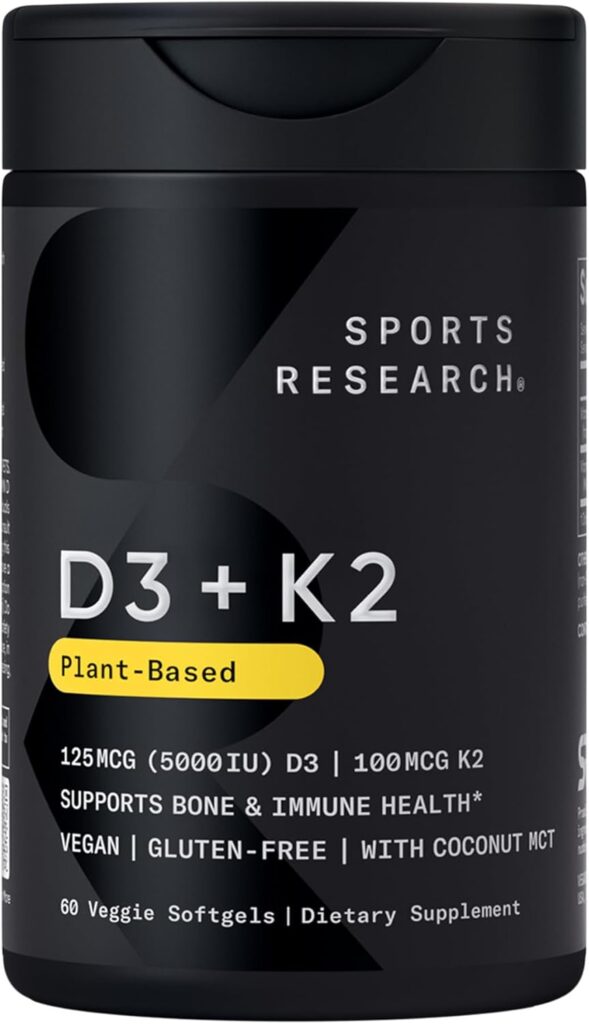
This formula solves the absorption problem directly by suspending the vitamin D3 in coconut MCT oil inside the softgel itself — meaning a fat source is present with every dose regardless of what else you’re eating at the time. At 5,000 IU per softgel, it’s a higher-potency option suited to those with confirmed lower levels; check with your doctor on appropriate dosing for your situation. Non-GMO verified, gluten and soy free, and manufactured in the US.
Best Combo Formula: Sports Research Vitamin D3 + K2 with Coconut Oil
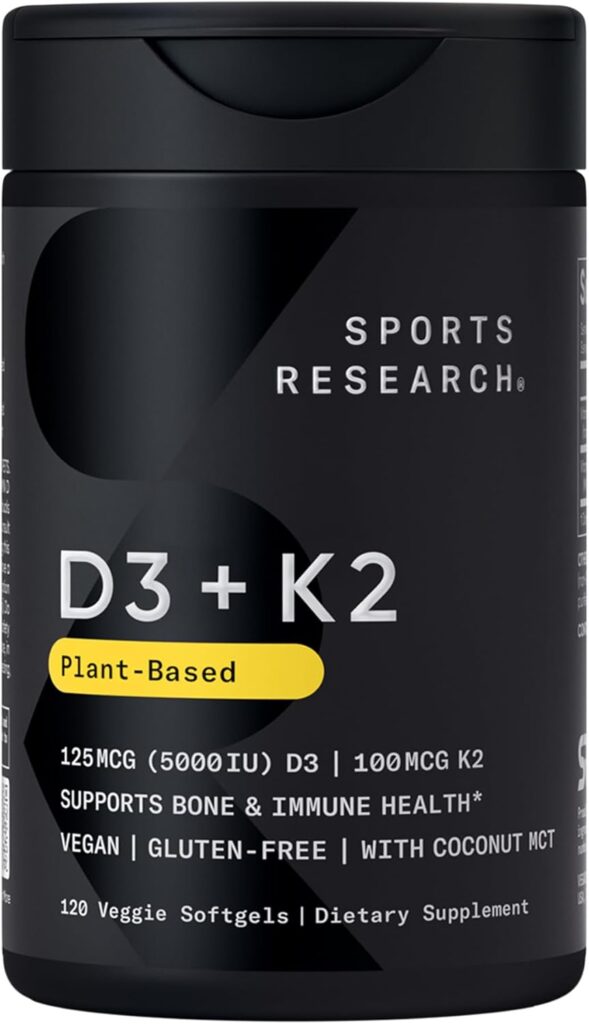
Vitamin K2 works alongside D3 in a genuinely complementary way — D3 increases calcium absorption, while K2 helps direct that calcium toward bones rather than soft tissue and arteries. This vegan-certified formula uses plant-based D3 from lichen and K2 (MK-7) from fermented chickpeas, again suspended in coconut MCT oil for built-in absorption support. Third-party tested and manufactured in a cGMP-compliant US facility.
Best Budget Option: NOW Foods Vitamin D-3 & K-2, 1,000 IU

For those who want a more moderate daily dose or are supplementing preventively rather than correcting a confirmed deficiency, NOW Foods’ D3/K2 combination offers the same complementary pairing at a lower 1,000 IU dose and a budget-friendly price point from a well-established, 50+ year supplement brand.
Frequently Asked Questions
Does taking vitamin D at night really disrupt sleep?
The evidence doesn’t strongly support this as a widespread effect. While vitamin D and melatonin interact biologically, and a 2021 review raised the theoretical concern, more recent research (including a 2024 review) suggests vitamin D may actually support better sleep quality overall. If you personally notice a sleep difference with evening dosing, switching to morning is a reasonable, low-cost adjustment — but there’s no strong evidence this applies universally.
Does it matter if I take vitamin D on an empty stomach?
Yes, more than timing of day does. Because vitamin D is fat-soluble, taking it on a completely empty stomach or with a very low-fat meal meaningfully reduces absorption. Pairing it with a meal containing dietary fat — even a modest amount — is the single most evidence-backed adjustment you can make.
Can I take vitamin D every day, or should I take breaks?
For most people at standard supplemental doses, daily use is appropriate and is how most clinical research on vitamin D is structured. Because vitamin D is stored in body fat and released gradually, missing an occasional day doesn’t meaningfully affect blood levels — but establishing a consistent daily habit, paired with a fat-containing meal, is more useful than strict adherence to a specific clock time.
How long does it take to see blood levels improve after changing when I take vitamin D?
Vitamin D has a relatively long half-life in the body, and meaningful changes in blood serum levels typically take several weeks to a few months of consistent supplementation to show up on a test. If you’re specifically testing whether taking it with a fattier meal improves your levels, allow at least 8–12 weeks before retesting to see a meaningful before-and-after comparison.
Should I take vitamin D3 or D2?
D3 (cholecalciferol) is generally considered more effective at raising and maintaining blood levels than D2 (ergocalciferol), and is the form used in all three supplements recommended in this guide. D3 is the form your skin naturally produces from sun exposure, which may explain why it’s more readily utilized by the body than the plant-derived D2 form.
The Bottom Line
The “morning or night” question is largely a wash based on current evidence — pick whichever consistently fits your routine. What genuinely moves the needle is pairing your vitamin D with a meal that contains dietary fat, a change shown to meaningfully increase absorption in real-world clinical observation. Beyond timing, factors like gut health conditions, certain medications, and individual genetic variation in vitamin D receptors matter more than the hour on the clock — worth discussing with your doctor if your levels aren’t responding as expected despite consistent supplementation.
For related content on nutrients and conditions that interact with vitamin D’s role in the body, see our guides on herbs for inflammation and natural remedies for joint pain, both of which touch on vitamin D’s broader role in bone and immune health.
This article is for informational purposes only. Always consult a qualified healthcare provider before starting any supplement or making changes to existing supplementation, particularly if you have a condition affecting nutrient absorption.