This article is for informational purposes only and does not constitute medical advice. Hemorrhoids (piles) can be a symptom of other conditions. Rectal bleeding should always be evaluated by a doctor. Always consult a qualified healthcare provider before starting any treatment.
What Are Piles — And Why Most Resolve With the Right Treatment
Piles — the common term for hemorrhoids — are swollen, inflamed veins in the rectum or around the anus. An estimated 75% of people experience hemorrhoids at some point in their lives, making this one of the most common conditions in the world despite being rarely discussed openly.
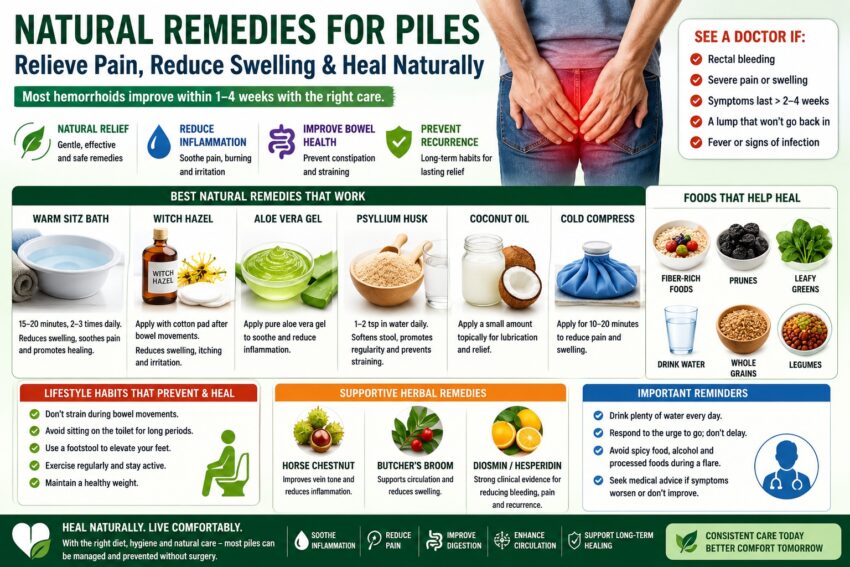
The good news: the majority of hemorrhoid cases — particularly internal hemorrhoids at grades 1 and 2, and external hemorrhoids without thrombosis — respond well to conservative natural treatment within 1–4 weeks. The combination of dietary fibre, adequate hydration, sitz baths, topical relief, and corrected bowel habits resolves most hemorrhoid flare-ups without medical procedures.
The less good news: some hemorrhoids don’t respond to home treatment, some cause complications requiring medical intervention, and some rectal symptoms people attribute to hemorrhoids are caused by something else — including conditions that require prompt attention. Understanding the difference is the most important thing this article can help you with.
See a Doctor If Any of These Apply
Check this list before relying on home treatment alone. Any of these warrants medical evaluation:
- Rectal bleeding — even if you’re sure it’s from hemorrhoids, rectal bleeding should always be evaluated by a doctor at least once to rule out colorectal cancer, inflammatory bowel disease, and diverticular disease. Never assume blood in the stool is “just hemorrhoids” without a professional assessment.
- Symptoms that don’t improve after 2–4 weeks of consistent home treatment
- Severe or suddenly worsening pain — particularly the constant, severe pain of a thrombosed external hemorrhoid (a blood clot), which often requires prompt medical treatment
- A lump that cannot be pushed back inside — suggests a prolapsed hemorrhoid requiring medical management
- Fever with rectal symptoms — possible infection
- You are over 40 and haven’t had a colorectal cancer screening — rectal symptoms in this age group warrant screening discussion
- You are pregnant — hemorrhoids are very common in pregnancy but management has specific considerations; discuss with your midwife or OB
Types of Piles — Understanding What You’re Treating
Natural remedies work differently depending on hemorrhoid type and severity.
Internal hemorrhoids are inside the rectum and not typically visible or felt. Graded 1–4:
- Grade 1: Slight bleeding, no prolapse — best response to natural treatment
- Grade 2: Prolapse during straining, retracts spontaneously — responds well to conservative treatment
- Grade 3: Prolapse requiring manual reduction — natural remedies help symptoms but may not resolve the condition
- Grade 4: Permanently prolapsed — typically requires medical intervention
External hemorrhoids are under the skin around the anus — visible, felt as a lump, and cause the burning, itching, and pain most people associate with piles. They respond well to topical natural remedies.
Thrombosed external hemorrhoids have a blood clot inside, causing sudden severe pain and a firm tender lump. These often require a doctor visit; home remedies provide limited relief for the acute clot.
The natural remedies in this article are most effective for Grade 1–2 internal hemorrhoids and external hemorrhoids without thrombosis — the most common clinical presentation.
Natural Remedies for Piles With Real Evidence
Warm Sitz Baths — First Line and Most Recommended
A sitz bath — sitting in 3–4 inches of warm water for 15–20 minutes — is the single most universally recommended home treatment for hemorrhoid symptoms. It’s recommended by the American Society of Colon and Rectal Surgeons (ASCRS), supported by multiple clinical studies, and provides immediate, meaningful relief for most people.
Warm water relaxes the internal anal sphincter (which is often chronically contracted in people with hemorrhoids), promotes blood circulation, reduces swelling, and soothes the burning and itching. A 2018 study published in Techniques in Coloproctology confirmed that sitz baths significantly reduced pain and improved patient satisfaction. Clinical guidance recommends 2–3 sitz baths daily during an active flare.
How to use: Fill a bathtub or sitz bath basin with comfortably warm — not hot — water. Sit for 15–20 minutes. Pat dry gently with a clean cloth. Plain warm water is sufficient — Epsom salts are optional and not proven to add benefit beyond the warm water itself.
Witch Hazel — Topical Astringent and Anti-Inflammatory
Witch hazel (Hamamelis virginiana) is a plant-derived astringent with well-documented anti-inflammatory, antipruritic, and haemostatic properties. It’s the active ingredient in Tucks pads — one of the most widely recommended hemorrhoid products — making this simultaneously a herbal remedy and a conventional pharmaceutical recommendation.
Its tannins cause localised vasoconstriction (tightening of blood vessels) that reduces swelling, and its anti-inflammatory compounds reduce the burning and itching of external hemorrhoids. A study in the European Journal of Pediatrics confirmed witch hazel’s significant anti-inflammatory and anti-irritant effects on skin.
How to use: Apply witch hazel to a cotton pad and gently apply to the affected area after each bowel movement and as needed. Use pure witch hazel — no alcohol, no added fragrance. Apply cold witch hazel (refrigerated) for additional soothing relief.
Aloe Vera Gel — Soothing and Anti-Inflammatory
Aloe vera has well-established anti-inflammatory, wound-healing, and tissue-soothing properties confirmed in a systematic review in the Annals of Dermatology. A clinical trial in the Journal of Research in Medical Sciences found aloe vera cream significantly reduced pain, itching, and bleeding in patients with chronic anal fissure — a related anorectal condition — compared to placebo.
How to use: Apply pure food-grade aloe vera gel (not a cosmetic product containing alcohol or fragrance) directly to the affected area. Refrigerate for additional cooling relief. Apply after bowel movements and sitz baths. The gel form is required — aloe drinks do not deliver topical benefit.
Psyllium Husk — The Most Important Dietary Intervention
Psyllium husk is a soluble fibre that forms a bulky, soft, gel-like stool that passes without straining — directly addressing the primary mechanical cause of hemorrhoid formation. A randomised controlled trial in Diseases of the Colon and Rectum found psyllium supplementation significantly reduced hemorrhoid bleeding and recurrence compared to placebo over 12 months — one of the stronger clinical findings for any single natural hemorrhoid intervention.
How to use: 1–2 teaspoons (5–10g) in a large glass of water, once or twice daily. Drinking plenty of water with psyllium is essential — without adequate hydration, psyllium can worsen constipation. Start with 1 teaspoon daily and increase gradually. Allow 1–3 days for stool softening effects.
Coconut Oil — Topical Relief
Organic virgin coconut oil reduces irritation and swelling through its anti-inflammatory properties, reduces friction during bowel movements through its lubricating quality, and provides mild antimicrobial protection through its lauric acid content. The evidence for hemorrhoids specifically is primarily mechanistic and anecdotal — high-quality clinical trials are limited — but its constituent properties address relevant aspects of external hemorrhoid symptoms safely and inexpensively.
How to use: Apply a small amount of organic unrefined coconut oil to the affected area with clean fingers or a cotton pad after bowel movements and sitz baths.
Cold Compresses — Swelling and Acute Pain Relief
Cold application reduces blood flow and swelling — directly relevant for the acute pain and swelling of external hemorrhoids. Most useful in the first 24–48 hours of an acute flare. Can be alternated with warm sitz baths for combined benefit — cold to reduce swelling, warm to promote circulation and sphincter relaxation.
How to use: Wrap ice or a cold pack in a clean cloth and apply to the affected area for up to 20 minutes at a time. Never apply ice directly to skin.
Apple Cider Vinegar — Separating Fact From Fiction
Apple cider vinegar is widely promoted online as a natural remedy for hemorrhoids — but this recommendation deserves a direct challenge. ACV is highly acidic (pH 3–4). Applied directly to inflamed, sensitive perianal tissue, it frequently worsens irritation and burning rather than relieving it. Several dermatological case reports document chemical burns from ACV applied to sensitive skin.
The honest recommendation: avoid applying ACV directly to hemorrhoids. The mechanism people cite is not supported by clinical evidence and the risks of irritation are real. If you want to take ACV internally as a general digestive tonic, diluted in water is the appropriate route — but it won’t directly treat hemorrhoids.
Herbal Remedies for Piles With Evidence
Horse chestnut (Aesculus hippocastanum) — Contains aescin, which has documented effects on venous tone, capillary permeability, and inflammation. A Cochrane systematic review found horse chestnut seed extract significantly reduced hemorrhoid symptoms — pain, bleeding, and itching — compared to placebo. The evidence quality is considered moderate, better than most herbal remedies for this condition. Use: standardised extract containing 16–20% aescin, 250–600mg daily. Allow 4–8 weeks. Safety: Avoid with blood thinners, kidney or liver disease, or during pregnancy. Never use raw horse chestnut (toxic — only standardised extract).
Butcher’s broom (Ruscus aculeatus) — Contains ruscogenins that stimulate constriction of blood vessels, directly addressing the venous dilation that contributes to hemorrhoid formation. A randomised, double-blind, placebo-controlled trial published in Arzneimittelforschung found butcher’s broom significantly reduced hemorrhoid symptoms including bleeding, pain, and discharge versus placebo. Use: standardised extract containing 9–11% ruscogenins, 100–200mg three times daily. Safety: Avoid during pregnancy. May interact with alpha-blockers and ACE inhibitors.
Flavonoids — diosmin and hesperidin (MPFF) — The strongest clinical evidence of any oral supplement for hemorrhoid treatment. Multiple randomised controlled trials and a Cochrane review found MPFF significantly reduces bleeding, pain, and recurrence. A systematic review in the International Journal of Surgery found flavonoids reduced the risk of persistent hemorrhoid symptoms by 47% and bleeding by 67% compared to placebo — one of the strongest effect sizes for any supplement in this condition. MPFF is a prescription drug in some European countries and a standard-of-care adjunct to hemorrhoid procedures in France and Italy. Use: 1,000mg MPFF (or 450mg diosmin + 50mg hesperidin) daily; available as diosmin supplements. Allow 4–8 weeks. Safety: Well-tolerated with mild GI side effects in some people.
Dietary Changes That Treat and Prevent Piles
Increase dietary fibre to 25–30g daily. Most Americans consume 10–15g — significantly below the recommended amount. Fibre softens and bulks the stool, reducing straining. Best sources: oats (soluble fibre), beans and lentils, flaxseed, prunes, apples and pears (with skin), broccoli, leafy greens, and whole grains. Increase fibre gradually to avoid gas and bloating.
Drink 8–10 glasses of water daily. Fibre without adequate water can worsen constipation. Hydration is the non-negotiable companion to any fibre increase.
Prunes and prune juice have genuine clinical evidence for softening stools and promoting bowel regularity — 4–6 prunes or 120ml of prune juice daily is a practical starting point.
Limit: Processed foods (low fibre, pro-inflammatory), spicy food (can irritate the perianal area during bowel movements), alcohol (dehydrating and increases venous pressure), and excessive red meat (low fibre, slow transit time).
Lifestyle Changes — The Most Important Long-Term Treatment
Don’t strain on the toilet. Straining is the primary mechanical cause of hemorrhoid formation. If a bowel movement requires significant effort, the stool is too hard — address fibre and hydration rather than pushing through.
Don’t sit on the toilet for extended periods. The toilet seat creates pressure on perianal vessels. The recommended guideline is no more than 5 minutes at a time. Reading or using a phone on the toilet while waiting extends this pressure unnecessarily.
Use a squatting position if possible. The squatting posture straightens the anorectal angle and reduces the effort required for defecation. A footstool (~7–9 inches) placed in front of the toilet elevates the feet to approximate the squatting position. Multiple clinical studies have found squatting reduces straining time and effort.
Move regularly. Prolonged sitting increases venous pressure in the pelvis and impairs blood return from the lower body. Regular movement throughout the day reduces hemorrhoid risk and helps healing.
Exercise regularly. Aerobic exercise improves intestinal transit time (reducing constipation), improves venous function, and reduces prolonged sitting — all relevant to hemorrhoid prevention and healing.
What to Avoid When You Have Piles
Dry toilet paper rubbing. Wiping with dry toilet paper on inflamed perianal tissue causes irritation and worsened inflammation. Switch to moist, unscented wipes or a bidet during a flare. Pat gently — never rub.
Scratching. Scratching breaks skin, introduces infection risk, and worsens the inflammatory cycle. Witch hazel, cold compresses, and hydrocortisone cream reduce itch without causing damage.
Delaying after the urge. When the urge to defecate comes, respond promptly. Holding stool allows further water reabsorption, hardens it, and makes subsequent passage more difficult and straining.
Constipation-promoting medications. Codeine, iron supplements, calcium carbonate antacids, and some antidepressants cause constipation. If you take these, discuss alternatives or adjuncts with your prescribing doctor.
When Natural Remedies Won’t Be Enough
Natural remedies reliably resolve Grade 1–2 internal hemorrhoids and most external hemorrhoids within 2–4 weeks of consistent treatment. For more advanced cases, medical options are safe, effective, and typically require no hospital admission:
- Rubber band ligation: Most common office-based procedure for Grade 2–3 internal hemorrhoids. A band cuts off blood flow; the hemorrhoid falls off within 1–2 weeks. Highly effective with minimal recovery.
- Sclerotherapy: A chemical solution injected to shrink Grade 1–2 internal hemorrhoids. Office-based, minimal discomfort.
- Infrared coagulation: Heat destroys hemorrhoid tissue. Effective for small internal hemorrhoids.
- Hemorrhoidectomy (surgery): Reserved for large Grade 3–4 internal hemorrhoids or severe external hemorrhoids. Most effective for severe cases with 2–4 weeks recovery.
If 4 weeks of consistent natural treatment hasn’t resolved your symptoms, a straightforward conversation with a colorectal surgeon or gastroenterologist is the next step — and modern hemorrhoid procedures are often quicker and less uncomfortable than people expect.
Frequently Asked Questions
Do natural remedies actually cure piles?
For Grade 1–2 internal hemorrhoids and uncomplicated external hemorrhoids — yes, for most people. The combination of dietary fibre, adequate hydration, sitz baths, topical witch hazel or aloe vera, and corrected bowel habits resolves most hemorrhoid flare-ups within 1–4 weeks. For Grade 3–4 or thrombosed hemorrhoids, natural remedies manage symptoms but are unlikely to resolve the underlying condition without medical assistance.
How long does it take for natural remedies to work on piles?
Sitz baths and topical treatments provide immediate symptomatic relief within minutes to hours. Dietary changes and fibre supplementation improve stool consistency within 1–3 days. Overall resolution of an acute flare with consistent treatment typically takes 1–4 weeks. Oral supplements (horse chestnut, flavonoids) need 4–8 weeks for meaningful effect.
What shrinks hemorrhoids fast?
No remedy shrinks hemorrhoids immediately. For fastest symptomatic relief: a warm sitz bath followed by cold witch hazel application addresses both inflammation and pain together. For fastest resolution: maximising fibre and water intake while eliminating straining tackles the root cause most directly. Flavonoid supplementation has the strongest oral evidence for accelerating resolution.
Can I sit down with hemorrhoids?
Yes — prolonged sitting worsens symptoms more than brief sitting. If sitting is painful or necessary for extended periods, a donut-shaped hemorrhoid cushion reduces pressure on the perianal area significantly. Avoid hard surfaces for extended periods during a flare.
What foods cause piles to flare up?
Spicy foods can worsen perianal burning during bowel movements without directly causing hemorrhoids. Low-fibre processed foods, alcohol, and dehydrating foods contribute to constipation and straining — the primary dietary drivers of hemorrhoid formation and worsening.
Is it safe to treat piles at home?
For most people with typical hemorrhoid symptoms (itching, discomfort, occasional mild bleeding), yes. The exception: rectal bleeding should always be evaluated by a doctor at least once — even if you’re confident it’s from hemorrhoids — to rule out other causes. And if symptoms don’t improve within 4 weeks of consistent treatment, see a doctor.
Final Thoughts
Hemorrhoids are uncomfortable, common, and — for most people — entirely manageable with the right combination of dietary fibre, adequate hydration, warm sitz baths, and topical natural remedies. The evidence for these approaches is genuine. They address the root causes (constipation, straining, venous congestion) rather than just masking symptoms.
The most important single step is fibre and water. Everything else supports this foundation. Add psyllium husk, increase vegetables and legumes, drink more water, and most Grade 1–2 hemorrhoid flares will resolve within weeks.
Witch hazel and sitz baths provide immediate relief while dietary changes work. Horse chestnut and diosmin/hesperidin address the venous pathology from the inside if symptoms persist. And if none of this resolves the issue within 4 weeks — or if symptoms are severe — modern hemorrhoid procedures are quick, effective, and often done in a clinic setting without general anaesthesia.
This article is for informational purposes only and does not constitute medical advice. Rectal bleeding should always be evaluated by a qualified healthcare provider. Always consult a doctor before starting any treatment, particularly if symptoms are severe, worsening, or have not improved with home treatment.