Medical Disclaimer: This article is for informational purposes only and does not constitute medical advice. Always consult a qualified healthcare provider before starting any new treatment, especially if you are pregnant, immunocompromised, or taking prescription medications.
That Tingling Feeling — And What to Do About It
You know the feeling. A subtle tingle or itch on your lip, and you already know what’s coming. Cold sores — caused by the herpes simplex virus type 1 (HSV-1) — affect roughly 67% of people under 50 worldwide, according to the WHO. There’s no cure, but that doesn’t mean you’re powerless.
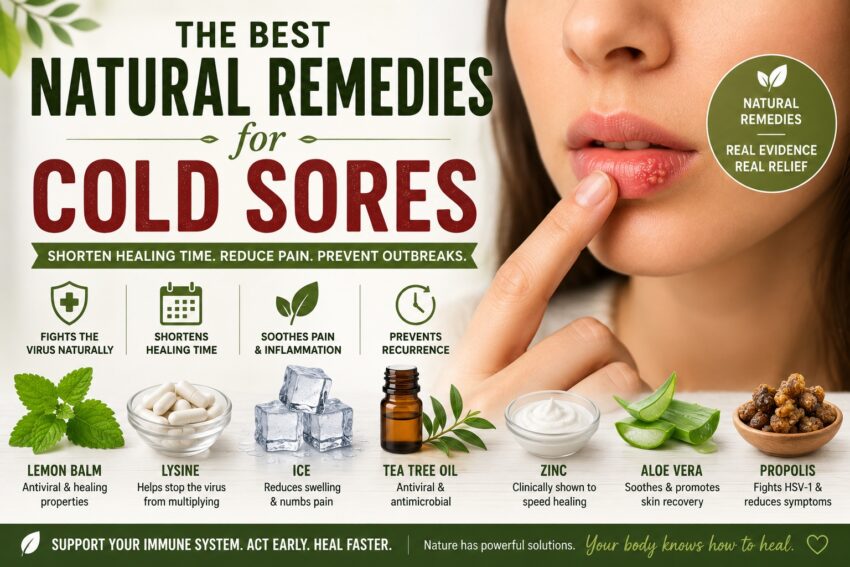
The goal with natural remedies for cold sores is simple: shorten healing time, reduce pain, and ideally stop the outbreak before it fully forms. Some options have solid evidence behind them. Others are popular but barely do anything. This guide separates the two.
How Cold Sores Work (So You Know When to Act)
Cold sores go through predictable stages: tingling, blistering, weeping, crusting, and healing. The tingling stage is your best window — catching it early can genuinely reduce how bad the outbreak gets.
HSV-1 hides in nerve tissue and reactivates when your immune system is stressed. Triggers include sun exposure, illness, hormonal changes, and fatigue. Knowing your triggers helps you act faster and reduce frequency over time.
Natural Remedies for Cold Sores With Real Evidence
1. Lemon Balm (Melissa officinalis)
Lemon balm is the most well-studied herbal remedy for cold sores. A 1999 study published in Phytomedicine found that a lemon balm cream significantly reduced healing time and prevented spread compared to placebo. Its antiviral compounds — particularly rosmarinic acid — appear to interfere with HSV-1 cell entry.
Apply a lemon balm lip balm or cream directly to the sore 2–4 times daily starting at the first tingle. Look for products standardized to at least 1% rosmarinic acid.
2. Lysine Supplements
L-lysine is one of the most popular natural approaches, and the evidence is reasonably supportive. Lysine competes with arginine — an amino acid HSV-1 needs to replicate. A meta-analysis in the Journal of Family Practice found that lysine supplementation at 1,000–3,000 mg/day during outbreaks reduced duration and recurrence in most participants.
During an active outbreak, many practitioners recommend 3,000 mg/day in divided doses. For prevention, 1,000 mg/day is commonly used. Lysine is also found in foods like chicken, fish, and dairy — while arginine-rich foods like nuts, chocolate, and oats may worsen outbreaks for some people.
3. Ice or Cold Compress
Applying ice at the first sign of a cold sore can reduce inflammation and slow viral activity in the area. It won’t stop the outbreak entirely, but it can make it less severe and ease pain. Wrap ice in a cloth and apply for 10–15 minutes several times a day.
This is one of the simplest and most accessible home remedies for cold sores — no products needed.
4. Tea Tree Oil
Tea tree oil has demonstrated antiviral activity against HSV-1 in laboratory settings. A study published in Antiviral Research found it active against acyclovir-resistant strains of the virus. Use it diluted — never apply undiluted essential oil directly to a cold sore.
Mix 1–2 drops of tea tree oil with a carrier oil (like coconut or jojoba) and apply with a clean cotton swab 2–3 times daily. If you’re exploring other herbal and essential oil applications, our guide on best natural hair oils and how to use them covers safe dilution practices worth knowing.
5. Zinc
Topical zinc — particularly zinc sulfate or zinc oxide — has good evidence for reducing cold sore severity and duration. A review in the British Journal of Dermatology concluded that topical zinc outperformed placebo in multiple trials. It’s thought to inhibit HSV-1 replication and boost local immune response.
Apply zinc-containing cream directly to the sore several times a day from the earliest stage. Zinc lozenges have also been studied, though evidence for cold sores specifically is thinner than for topical application.
6. Aloe Vera Gel
Aloe vera has anti-inflammatory and antiviral properties. Research published in Antiviral Research showed aloe vera extract inhibited HSV-1 in vitro. While clinical evidence in humans is less robust, aloe gel is soothing, widely available, and unlikely to cause harm.
Use pure aloe vera gel (not lotion with added fragrance) and apply a thin layer to the sore up to four times daily. It’s particularly helpful in the crusting stage when skin feels tight and painful.
7. Propolis
Propolis — a resin-like substance produced by bees — has emerged as one of the more promising natural cold sore treatments. A clinical trial published in Phytomedicine compared a 3% propolis ointment to acyclovir cream and found comparable results for reducing healing time and pain.
Apply topical propolis ointment at first tingle. Note: if you have a bee allergy, avoid propolis entirely.
Remedies That Are Popular But Weak on Evidence
| Remedy | What People Claim | Actual Evidence |
|---|---|---|
| Vanilla extract | Shortens outbreak duration | No clinical studies; alcohol content may dry skin |
| Hydrogen peroxide | Kills the virus topically | Can damage tissue; no clinical support for HSV-1 |
| Toothpaste | Dries out the sore | Anecdotal only; can irritate skin further |
| Garlic | Antiviral properties | In vitro data only; raw garlic on skin can cause burns |
| Peppermint oil | Antiviral, cooling effect | Some lab evidence; insufficient human trials; must dilute |
| Witch hazel | Dries and heals faster | No robust evidence for HSV-1 specifically |
Skip anything that could break the skin barrier further, like undiluted oils or abrasive applications. Damaging the sore increases the risk of bacterial infection and scarring.
Lifestyle Factors That Influence Healing and Recurrence
Immune Support
HSV-1 reactivates when the immune system is under pressure. Prioritizing sleep, managing stress, and eating a nutrient-dense diet genuinely reduces outbreak frequency for many people. Zinc, vitamin C, and vitamin D are particularly relevant for immune defense — all worth evaluating if you experience frequent outbreaks.
If you’re looking at broader immune-supporting herbal approaches, our guide to herbal remedies that work covers several herbs with solid immune-modulating evidence.
Sun Protection
UV exposure is a well-established cold sore trigger. Use an SPF lip balm year-round, especially if you know sun is a personal trigger. This isn’t just a summer concern — winter sun and reflected snow can trigger outbreaks just as easily.
Avoid Touching and Spreading
HSV-1 is contagious from the first tingle until the sore is fully healed. Wash hands after touching the area, avoid kissing or sharing utensils, and don’t touch your eyes — the virus can cause serious eye infections (herpes keratitis) if transferred.
What About Mouth Ulcers? (They’re Not the Same)
Cold sores and mouth ulcers are often confused. Cold sores form on the outside of the lip or around the mouth and are caused by HSV-1. Mouth ulcers (canker sores) form inside the mouth and are not caused by a virus. They require different treatment approaches.
If you’re dealing with inside-the-mouth sores, our article on how to cure mouth ulcers fast naturally covers what actually helps for those.
Recommended Products Worth Considering
These are real products available on Amazon that align with the evidence-based remedies above. They’re included as a convenience — always read labels and verify they’re appropriate for your situation.
- Lemon Balm Lip Balm — Look for options with standardized lemon balm extract. Search lemon balm lip balm on Amazon
- L-Lysine Supplements (1000mg) — Search L-Lysine supplements on Amazon
- Topical Propolis Ointment — Search propolis ointment on Amazon
- Zinc Oxide Cream — Search zinc oxide cream on Amazon
When to See a Doctor
Most cold sores heal on their own within 7–10 days. But there are situations where natural remedies aren’t enough and medical treatment is necessary.
- Outbreaks more than 6 times per year — prescription antivirals like acyclovir or valacyclovir can significantly reduce frequency
- Sores near the eyes — herpes keratitis can cause vision damage and needs immediate evaluation
- Sores that don’t heal within 2 weeks — may indicate secondary bacterial infection or another condition
- You are immunocompromised (HIV, chemotherapy, organ transplant) — HSV-1 can cause severe complications
- Sores in a newborn or infant — neonatal herpes is a medical emergency
- Severe pain, fever, or swollen lymph nodes accompanying an outbreak
The CDC and AAP both recommend prompt antiviral treatment in high-risk populations. Don’t delay seeking care if any of the above applies.
Frequently Asked Questions
How fast can a cold sore heal with natural remedies?
With early treatment — especially lemon balm, zinc, or propolis applied at the tingling stage — some people see outbreaks resolve in 4–6 days instead of the typical 7–10. Results vary significantly based on the individual and how quickly they start treatment.
Does lysine really work for cold sores?
The evidence is reasonably strong for reducing severity and recurrence. Lysine supplementation at 3,000 mg/day during active outbreaks has shown benefits in multiple studies, though it’s not effective for everyone. It’s one of the better-supported natural remedies for cold sores.
Can you use tea tree oil directly on a cold sore?
Never apply undiluted tea tree oil to skin. Always dilute to 1–2% in a carrier oil before applying. Undiluted application can cause chemical burns and worsen irritation.
What makes cold sores worse?
Sunlight, stress, illness, hormonal changes, lack of sleep, and a diet high in arginine (nuts, chocolate, seeds) are the most common triggers. Addressing these reduces both outbreak severity and frequency.
Are cold sores contagious even without a visible blister?
Yes. HSV-1 can be shed asymptomatically, meaning the virus can spread even when no sore is visible. During an active outbreak — from tingle to full healing — transmission risk is highest.
Is there any natural remedy that stops a cold sore completely?
Nothing natural has been shown to prevent an outbreak once HSV-1 reactivates. However, acting at the very first tingle with topical lemon balm, zinc, or propolis can sometimes abort the blister from forming fully. Prescription antivirals are more reliable for this purpose.
Summary
Cold sores are frustrating, but you’re not without options. The strongest natural remedies for cold sores are lemon balm, lysine, zinc, and propolis — all with real clinical data behind them. Aloe vera and diluted tea tree oil are reasonable additions for symptom relief. Skip anything that could break the skin barrier or cause further irritation.
The most important thing: act early. The tingling stage is your window. Miss it, and you’re managing rather than preventing. Combined with smart lifestyle habits — sleep, stress management, sun protection, and immune support — you can meaningfully reduce both how often and how severely cold sores affect you.
If you’re dealing with frequent outbreaks, don’t write it off as something you just have to live with. A doctor can prescribe antivirals that offer more reliable control — and that’s a reasonable choice, not a last resort.
Medical Disclaimer: This content is for informational purposes only and is not a substitute for professional medical advice, diagnosis, or treatment. Always seek the advice of your physician or other qualified health provider with any questions you may have regarding a medical condition. Never disregard professional medical advice or delay seeking it because of something you have read here.